
Are Your Google Reviews Showing Up in Your Search Ads? What AI Review Summaries Mean for Local Businesses
October 27, 2026
How Should Dentists Run Google Ads?
October 27, 2026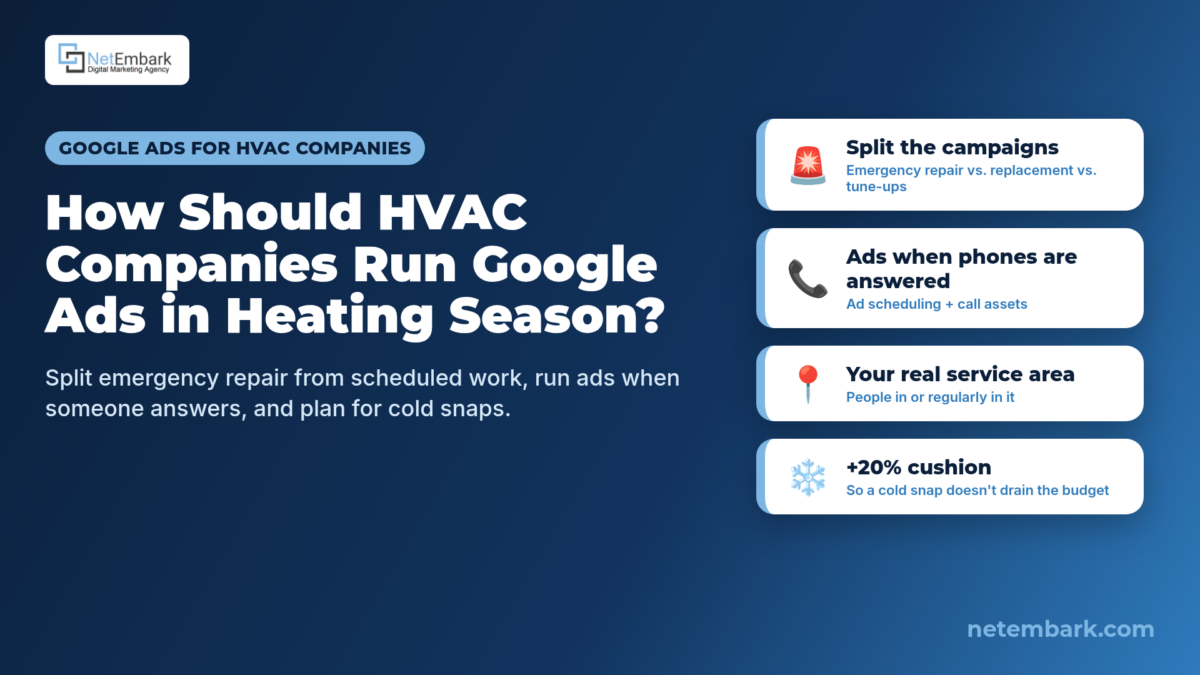
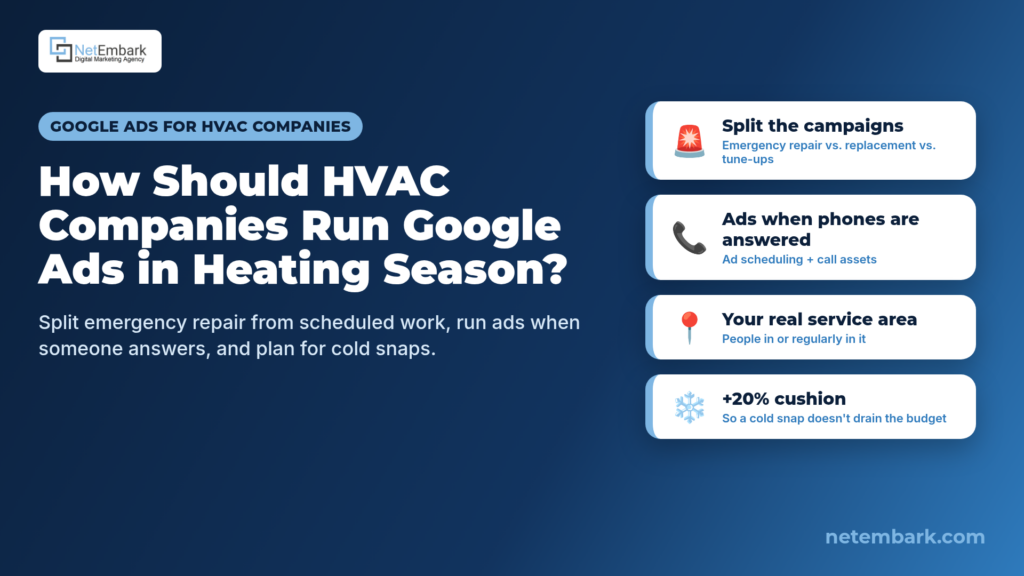
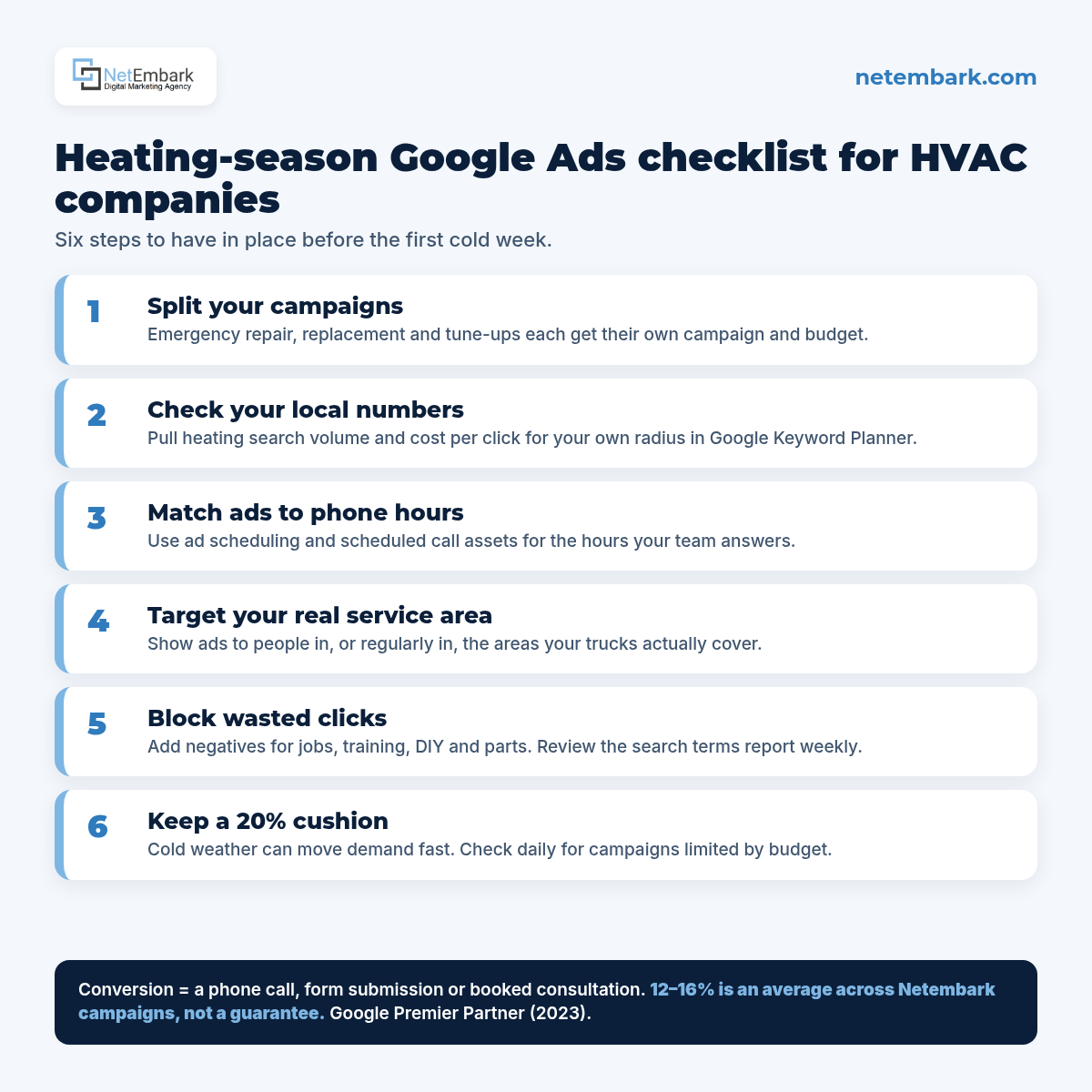
Short answer: Treat heating season as three different jobs. Put “no heat” emergency repair, furnace and heat pump replacement, and tune-ups in separate Google Ads campaigns with their own budgets. Run call-first emergency ads only during hours someone answers the phone, target the area you actually serve, and add a 20% budget cushion so a cold snap doesn’t use up the day’s budget early.
Video transcript
- How should HVAC companies run Google Ads in heating season? Here's a simple plan to have in place before the first cold snap.
- Split emergency work from scheduled work. No-heat searches need call-first ads. Replacements and tune-ups get their own campaigns and budgets.
- Run ads when someone answers. Use ad scheduling and call assets for the hours your team picks up the phone, and target the area you actually serve.
- Plan for cold snaps. Build the budget from your job goal, add a 20 percent cushion, and block searches like jobs, training and do-it-yourself.
- Measure booked jobs, not clicks. Netembark campaigns average a 12 to 16 percent conversion rate. That's an average, not a guarantee.
- Get your estimate with our free budget estimator at netembark.com/budget-calculator, or book a call at netembark.com/contact-us or (800) 707-2697.
Estimate your Google Ads budget → · Get Started · Call (800) 707-2697
What changes in HVAC Google Ads when heating season starts?
Searches shift from cooling to heating, and the most valuable ones get more urgent. A homeowner typing “furnace not working” or “no heat repair near me” on a cold evening wants someone on the phone now. Someone searching “furnace replacement” or “heat pump installation” is planning a bigger purchase and may compare a few companies over days or weeks.
Those searches need different ads, different landing pages and different budgets. If your account was built around summer AC repair, heating season is the time to restructure it, not just raise the budget.
Before you change anything, look up your heating terms in Google Keyword Planner set to your own city or service radius. It shows search volume and top-of-page bid ranges for your area, which is a better planning number than a national average.
Should emergency heating repair and furnace replacement be separate campaigns?
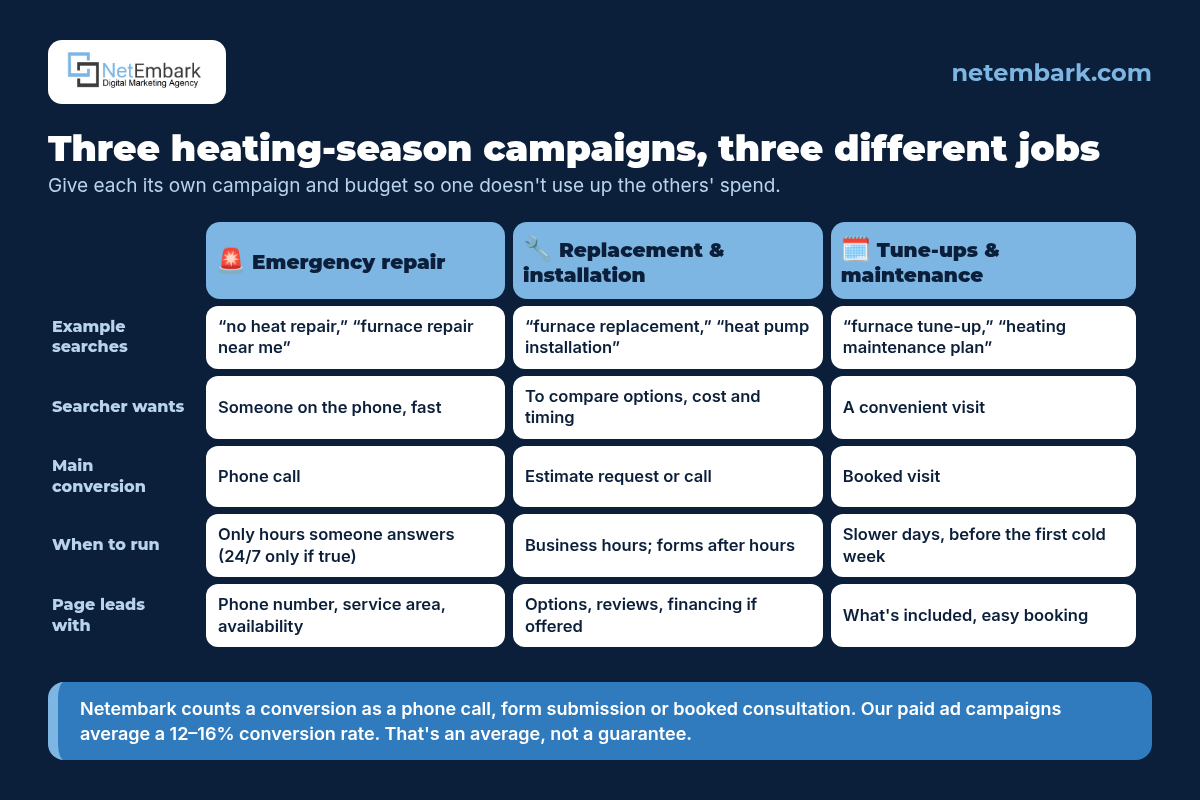
Yes. Heating season is really three different jobs, and each works best as its own campaign with its own budget:
- Emergency repair (“no heat,” “furnace repair near me,” “boiler repair today”): call-first ads, a call asset, and a landing page with your phone number at the top. Only promise same-day or 24/7 service if you really offer it.
- Replacement and installation (“new furnace,” “heat pump installation,” “furnace replacement”): ads and pages that answer questions about options, timing and financing (if you offer it), with an estimate request form next to the phone number.
- Tune-ups and maintenance (“furnace tune-up,” “heating maintenance plan”): lower urgency, and useful for filling slower days before the first cold week.
When all three share one campaign and one budget, the busiest searches usually win. On a cold morning that can leave nothing for the replacement jobs that are often worth more to your business. Separate campaigns let you decide where the money goes.
When should HVAC heating ads run?
Run call-first ads when someone will actually answer. Google Ads ad scheduling lets you choose the days and hours your ads show and raise or lower bids by time of day. Call assets can also be scheduled so the call button only shows when your business is taking calls.
If you offer true 24/7 emergency service, keep the emergency campaign running overnight and make sure after-hours calls reach a person. If you don’t, pause the call-first ads after hours and let your replacement and tune-up campaigns collect form requests for the morning. A missed call from a family with no heat is a lead you paid for and lost.
Check your location targeting too. Google lets you show ads to people who are in or regularly in your locations, or to people who have shown interest in them. For a business that drives to the job, people physically in your service area are usually the ones you want.
How do you keep a cold snap from draining your HVAC ad budget?
Start from the jobs you want, not a round number. Decide how many heating jobs you want from Google in a month, divide by your booking rate to get leads, divide leads by your conversion rate to get clicks, and multiply clicks by your local cost per click. Then add a 20% cushion on top of that base ad spend, because the first cold week is when demand can rise fastest. Our free Google Ads budget estimator does this math for you.
Google Ads runs on an average daily budget. Google’s help on setting an average daily budget says to divide a monthly budget by 30.4 to get the daily figure. During cold weather, check every day whether any campaign shows as limited by budget, and move money toward the campaign that is producing booked jobs.
If you use Smart Bidding and know a short spike is coming, such as a forecast cold snap, Google’s seasonality adjustments let you tell the system to expect a change in conversion rate. Google says they work best for short events of about 1 to 7 days and should only be used for major expected changes, because Smart Bidding already accounts for normal seasonal swings.
Which searches should HVAC companies keep out of their ads?
Heating searches pull in plenty of clicks that will never become jobs. Add negative keywords for the ones that don’t fit your business, for example:
- Job seekers: “HVAC jobs,” “HVAC technician salary,” “HVAC school”
- Do-it-yourself research: “how to relight a pilot light,” “furnace filter size,” “thermostat manual”
- Parts and supply: “furnace parts,” “wholesale”
- Equipment or fuel types you don’t service
Then read the search terms report every week during heating season. It shows the actual searches that triggered your ads, which is where new negative keywords, and new keywords worth bidding on, come from.
How do you know heating-season ads are working?
Count booked work, not clicks. Netembark counts a conversion as a phone call, form submission or booked consultation (for HVAC, usually a service visit or an estimate), and tracks each one back to the campaign and keyword that produced it. Review emergency, replacement and tune-up campaigns separately, because each has a different job to do.
On average, Netembark’s paid ad campaigns generate a 12–16% conversion rate. That is an average across our campaigns, not a guarantee; your rate depends on your service area, offer, landing page and how quickly your team answers and follows up.
How does Netembark help HVAC companies with heating-season ads?
Netembark is a verified Google Partner (Google Premier Partner 2016–2023) that builds Google Ads campaigns for HVAC contractors and other home service companies around real local searches and tracked calls, forms and booked visits. Campaigns typically go live within 2–4 days of signing the insertion order.
See how we approach the trade on our Google Ads for HVAC contractors page and our home services page, run your numbers in the Google Ads budget estimator (or the Local Services Ads budget estimator if you also run LSA), or browse more answers on the Netembark blog.
Estimate your Google Ads budget → · Get Started · Call (800) 707-2697
Frequently asked questions
How should HVAC companies run Google Ads in heating season?
Split emergency heating repair, replacement and installation, and tune-ups into separate campaigns with their own budgets. Run call-first emergency ads only during hours someone answers the phone, target the area you actually serve, block searches that won't become jobs, and add a 20% budget cushion for cold snaps.
Should emergency furnace repair have its own Google Ads campaign?
Yes. No-heat searches are urgent and phone-driven, while replacement searches are often researched over days or weeks. A separate campaign keeps emergency demand from using up the budget for replacement and maintenance work, and lets you write ads and landing pages for each kind of customer.
Should HVAC Google Ads run 24 hours a day?
Only if someone answers the phone 24 hours a day. Use ad scheduling and scheduled call assets to match call-first ads to the hours your team takes calls. If you don't offer overnight service, let form-based campaigns collect after-hours requests for the morning.
How do I keep a cold snap from using up my HVAC ad budget?
Build the budget from your job goal and local cost per click, add a 20% cushion, and check daily for campaigns limited by budget. If you use Smart Bidding, Google's seasonality adjustments are designed for short expected changes of about 1 to 7 days.
What conversion rate can an HVAC company expect from Google Ads?
Netembark counts a conversion as a phone call, form submission or booked consultation. Across our paid ad campaigns the average is 12 to 16 percent. That is an average, not a guarantee; your rate depends on your market, offer, landing page and how quickly calls are answered.
How can I get a heating-season Google Ads budget estimate?
Use Netembark's free Google Ads budget estimator, or book a call on our Contact Us page or at (800) 707-2697, Monday to Friday, 8:30 AM to 5:00 PM ET.
Want your heating-season campaigns ready before the next cold snap? Get Started or call (800) 707-2697.
Netembark LLC · Verified Google Partner (Google Premier Partner 2016–2023) · 42 E Main St, Suite 202, Freehold, NJ 07728 · (800) 707-2697 · info@netembark.com · @netembark
Want help with your Google Ads?
Book a free strategy call with our verified Google Partner team. We’ll review your account and show you where the leads are.

Gary Pyatigorsky is the founder and CEO of Netembark, a verified Google Partner agency (Google Premier Partner 2016–2023) managing Google Ads, SEO and AEO since 2009.