Where Do AI Max and PMax Help, and Where Should a Strategist Steer?
November 19, 2026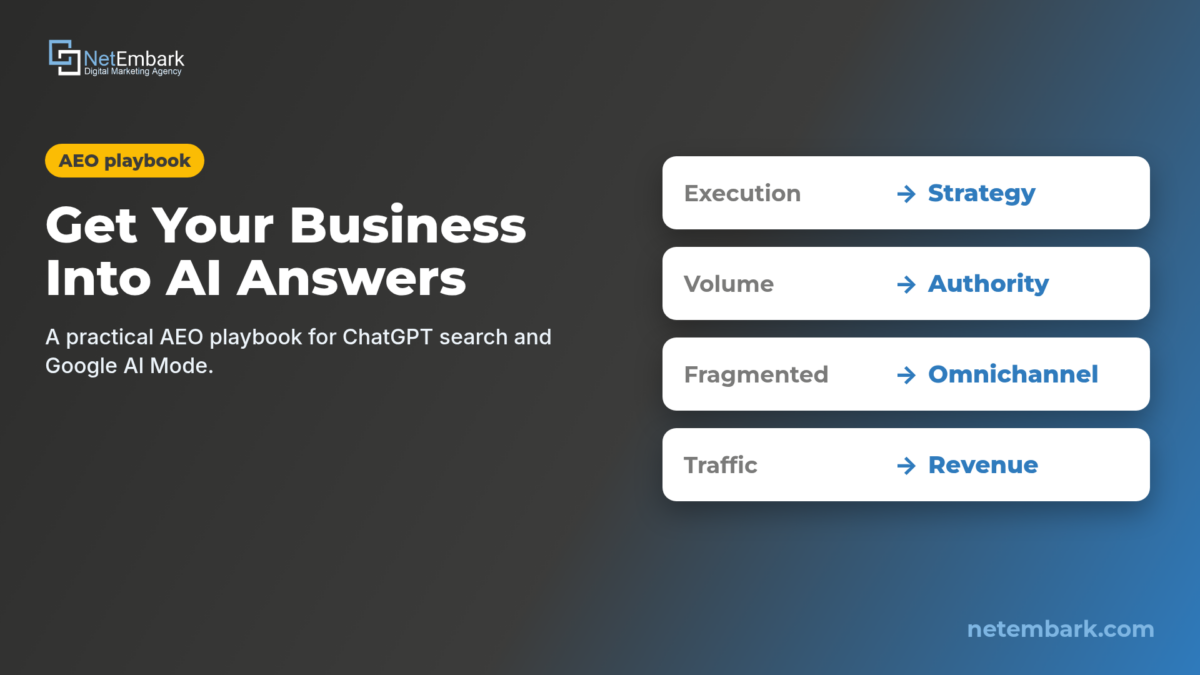
Short answer: There’s no separate sign-up for AI answers. Google says a page needs to be indexed and eligible for a snippet to appear as a link in AI Overviews or AI Mode, with no extra technical requirements, and OpenAI says a site needs to let its OAI-SearchBot crawl it to be eligible for ChatGPT search. After that, the work is the work that earns trust anywhere: pages that answer real customer questions in the first lines, first-hand detail and sources, accurate business listings, and fresh content. Measure it with Search Console’s generative AI report and Bing’s AI Performance report, and judge it by calls, forms and booked consults.
What decides whether an AI answer mentions your business?
Two things: whether the AI system can reach and index your pages, and whether your pages are a useful, trustworthy source for the question being asked. Google and OpenAI both say there’s no special sign-up for organic AI answers, and both say placement isn’t guaranteed.
Google is direct about it: “There are no additional requirements to appear in AI Overviews or AI Mode, nor other special optimizations necessary.” To be shown as a supporting link, “a page must be indexed and eligible to be shown in Google Search with a snippet” (Google Search Central). Google also explains that both features “may use a ‘query fan-out’ technique,” issuing related searches across subtopics to build one response. A single customer question can pull in pages that answer the smaller questions inside it.
OpenAI says “ChatGPT ranks search results using multiple factors intended to help users find relevant, reliable information. Placement is not guaranteed.” ChatGPT search “typically rewrites your query into one or more targeted queries” that it sends to search partners, and it can use an approximate location from the user’s IP address for local results (OpenAI Help Center).
Both systems break a question into smaller searches and then pick a few sources. The practical job is to be one of those sources: reachable, indexed, and clearly the best answer to a specific question.
Video transcript
- How to get your business into AI answers on ChatGPT search and Google AI Mode.
- Step one: let the crawlers in. Allow Googlebot and OpenAI's OAI-SearchBot, including at your host and CDN.
- Step two: write answer-first pages. One page per real customer question, with the answer in the first lines.
- Step three: add proof, not volume. First-hand detail and sources beat hundreds of thin AI posts.
- Step four: fix your listings. Keep Google Business Profile, Bing Places and ChatGPT Business Hub accurate and consistent.
- Skip the shortcuts. Google says you don't need special AI text files or schema to appear in AI Overviews or AI Mode.
- Measure it: Search Console's generative AI report and Bing's AI Performance report, then calls, forms and booked consults.
- Want your business in AI answers? Visit netembark.com, call 800-707-2697, or email info@netembark.com.
What's the practical AEO playbook, step by step?
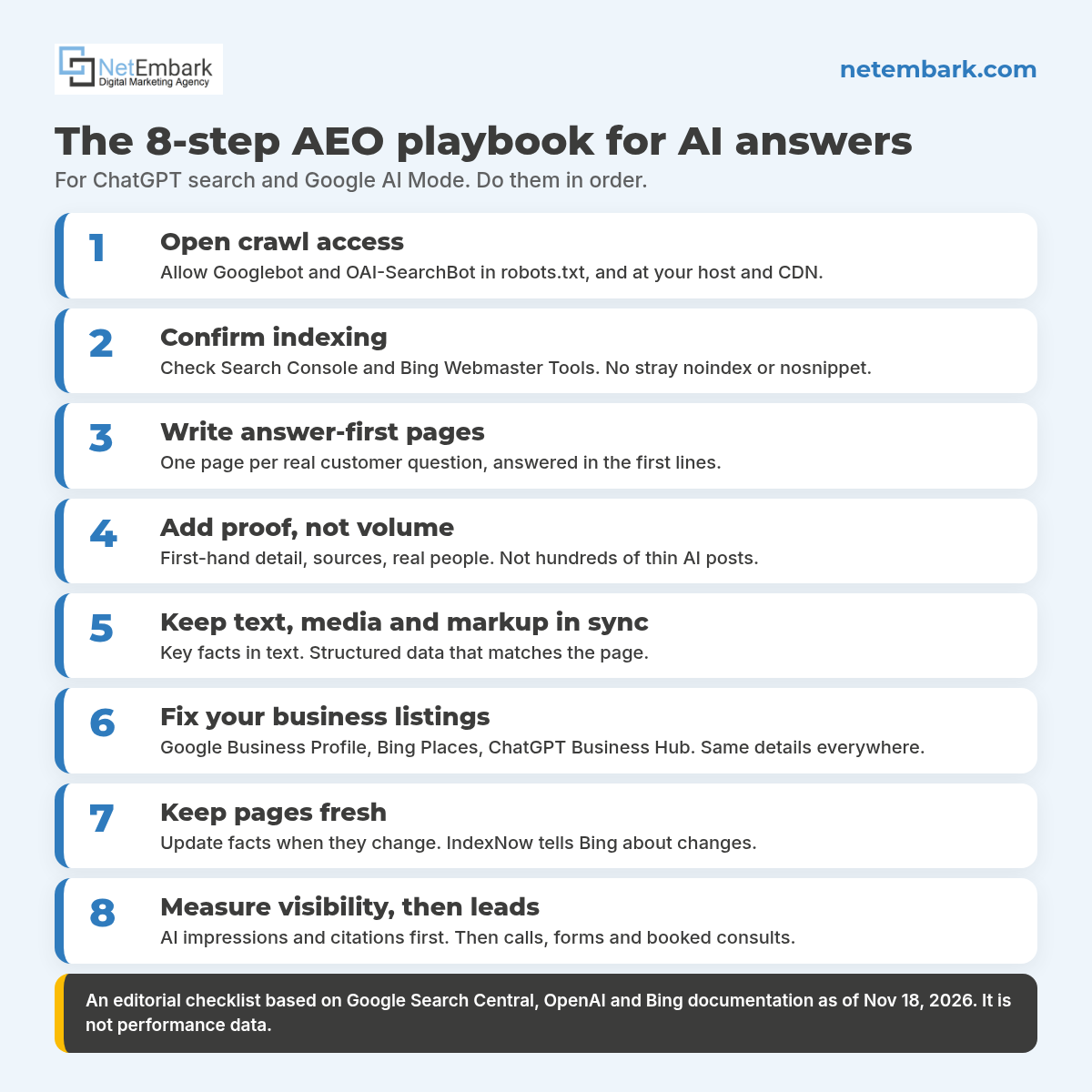
Eight steps, in order: open crawl access, confirm indexing, write answer-first pages, add proof instead of volume, keep text, media and markup in sync, fix your business listings, keep pages fresh, and measure what shows up and what turns into leads. Answer engine optimization (AEO) is mostly SEO fundamentals done carefully, with a few AI-specific checks.
| Step | Google (AI Overviews, AI Mode) | ChatGPT search and Microsoft Copilot |
|---|---|---|
| 1. Open crawl access | Allow Googlebot in robots.txt and at your CDN or host | Allow OAI-SearchBot and OpenAI’s published IP addresses; keep Bingbot allowed |
| 2. Confirm indexing | Pages must be indexed and eligible for a snippet; check URL Inspection | Verify the site in Bing Webmaster Tools; no stray noindex on key pages |
| 3. Answer first | Answer the question and its likely follow-ups (AI Mode uses query fan-out) | Same pages; ChatGPT rewrites questions into targeted searches |
| 4. Add proof | Original information, clear sourcing, who wrote it and why you’re qualified | Bing advises evidence, examples and cited sources |
| 5. Keep formats in sync | Key content in text; structured data matches the page; no special AI files | Text, images and video describe the same business and services |
| 6. Fix business info | Business Profile and Merchant Center up to date | Bing Places listing; claim your business in ChatGPT Business Hub |
| 7. Keep it fresh | Update pages when facts change; request a recrawl after big changes | IndexNow notifies Bing; OpenAI says robots.txt changes take about 24 hours |
| 8. Measure | Search Console generative AI performance report (impressions) | Bing AI Performance (citations, grounding queries); chatgpt.com referrals in analytics |
1. Open crawl access
Google’s list of SEO practices for AI features starts with “Ensuring that crawling is allowed in robots.txt, and by any CDN or hosting infrastructure” (Google Search Central). OpenAI asks sites to “allow OAI-Searchbot to crawl the site and confirm that the website host or content delivery network allows traffic from OpenAI’s published searchbot IP addresses” (OpenAI Help Center). Sites that block OAI-SearchBot “will not be shown in ChatGPT search answers, though can still appear as navigational links” (OpenAI).
One common mix-up: GPTBot, OpenAI’s training crawler, is a separate setting. OpenAI says “a webmaster can allow OAI-SearchBot in order to appear in search results while disallowing GPTBot” (OpenAI). Firewalls and bot-protection tools can also block these crawlers without anyone noticing, so we check the host and CDN settings, not just robots.txt. More on training versus search in the new robots.txt AI-training signal.
2. Confirm indexing
Verify the site in Search Console and run URL Inspection on your key service pages. Preview controls matter here: Google says “More restrictive permissions will limit how your content is featured in our AI experiences,” and lists nosnippet, data-nosnippet, max-snippet and noindex (Google Search Central Blog). We also verify sites in Bing Webmaster Tools. Bing’s AI reporting covers Microsoft Copilot, AI summaries in Bing and “select partner integrations” (Bing Webmaster Blog), and OpenAI’s help page links Microsoft’s privacy statement among the search providers ChatGPT search works with (OpenAI Help Center). Healthy Bing indexing is a sensible step for ChatGPT visibility too; that part is our judgment, not an OpenAI statement.
3. Write answer-first pages for real questions
Build one page around each question customers actually ask, and answer it in the first two or three sentences. Use question headings, short lists and tables. Bing’s guidance says “Clear headings, tables, and FAQ sections help surface key information and make content easier for AI systems to reference accurately” (Bing Webmaster Blog). Google says people in its AI search experiences are “asking longer and more specific questions,” plus follow-ups (Google Search Central Blog), so cover those follow-ups too: who it’s for, how long it takes, what to expect, how options compare.
The best questions come from your own sales calls, intake forms and emails, plus People Also Ask and the queries in Search Console. This post uses the same format: a short answer up top, then each section opens with a direct answer.
4. Add proof, not volume
Google’s self-check for helpful content asks, “Does the content provide original information, reporting, research, or analysis?” and whether it shows “clear sourcing, evidence of the expertise involved, background about the author or the site” (Google Search Central). Bing gives similar advice: “Support claims with evidence” (Bing Webmaster Blog).
Mass-produced pages work against you. Google’s spam policies name “Using generative AI tools or other similar tools to generate many pages without adding value for users” as scaled content abuse, and define spam to include “attempting to manipulate generative AI responses in Google Search” (Google Search Central). We go deeper in why 500 AI blog posts won’t help your SEO.
5. Keep text, media and markup in sync
Google recommends “Making sure that important content is available in textual form,” supporting it with images and video, and “Making sure your structured data matches the visible text on the page.” It also says “You don’t need to create new machine readable files, AI text files, or markup to appear in these features. There’s also no special schema.org structured data that you need to add” (Google Search Central). Bing advises aligning “text, images, and video so they consistently represent the same entities, products, or concepts” (Bing Webmaster Blog).
Our approach: standard schema (Organization, LocalBusiness, FAQ where the page really has one) that repeats what the page already says. Hours, phone number and services in plain text, not only inside an image.
6. Fix your business listings
Google’s AI features guidance includes “Checking that your Merchant Center and Business Profile information is up-to-date” (Google Search Central). Google Business Profile Help says “Businesses with complete and accurate info are more likely to show up in local search results,” that “More reviews and positive ratings can help your business’s local ranking,” and that “There’s no way to request or pay for a better local ranking on Google” (Google Business Profile Help). Bing points local businesses to Bing Places so address, hours and contact details stay “eligible for inclusion in AI-generated responses” (Bing Webmaster Blog).
On the ChatGPT side, businesses can now claim a listing in ChatGPT Business Hub; we walk through it in how to claim your business in ChatGPT Business Hub. Keep the name, address, phone, hours and services identical across all of them. See also how law firms get more clients from Google Business Profile.
7. Keep pages fresh
Bing’s advice is to “Keep content fresh and accurate,” and it recommends IndexNow, which notifies participating search engines “whenever content is added, updated, or removed” (Bing Webmaster Blog). When services, hours or locations change, update the page first and the listings the same day. OpenAI notes that after a robots.txt change, “it can take ~24 hours” for ChatGPT search to adjust (OpenAI).
8. Measure visibility, then leads
Search Console’s generative AI performance report shows impressions in AI Overviews and AI Mode by page, country, device and date; Google says it rolled out to all websites as of August 31, 2026 (Search Console Help). An impression there is how many times “links to your site were shown to a user in a generative AI feature.” Bing Webmaster Tools’ AI Performance report shows total citations, cited pages and the “grounding queries” behind them across Copilot and partner experiences (Bing Webmaster Blog). For ChatGPT, we watch visits referred from chatgpt.com in analytics.
None of those are leads. Google itself suggests “looking at various indicators of conversion on your site” rather than focusing only on clicks (Google Search Central Blog). We track calls, forms and booked consultations from these visits. Our walkthrough of the Search Console report is in how to tell if your business shows up in Google’s AI answers.
What should you skip?
Skip the shortcuts: special AI files or schema Google says it doesn’t need, hundreds of thin AI-written pages, hidden text or tricks aimed at AI answers, and anyone promising guaranteed placement in ChatGPT or Google AI Mode.
- “AI files” and special markup. Google says no new machine-readable files, AI text files or special schema are needed for AI Overviews or AI Mode (Google Search Central). Time spent there is better spent on the pages themselves.
- Volume publishing. Generating many pages “without adding value for users” is scaled content abuse under Google’s spam policies (Google Search Central).
- Hidden text and manipulation. White-on-white text, off-screen text and other hidden content are spam, and Google’s spam definition covers attempts “to manipulate generative AI responses in Google Search” (Google Search Central).
- Guaranteed placement. Google says “Indexing and serving isn’t guaranteed” (Google Search Central), and OpenAI says “Placement is not guaranteed” (OpenAI Help Center). Anyone selling a guaranteed spot in an organic AI answer is selling something neither company offers.
- Blocking the wrong bot. Blocking OAI-SearchBot to stop AI training also removes you from ChatGPT search answers. GPTBot is the training setting (OpenAI).
Talk to Netembark about getting your business into AI answers → · Call (800) 707-2697
How does AEO change the agency model?
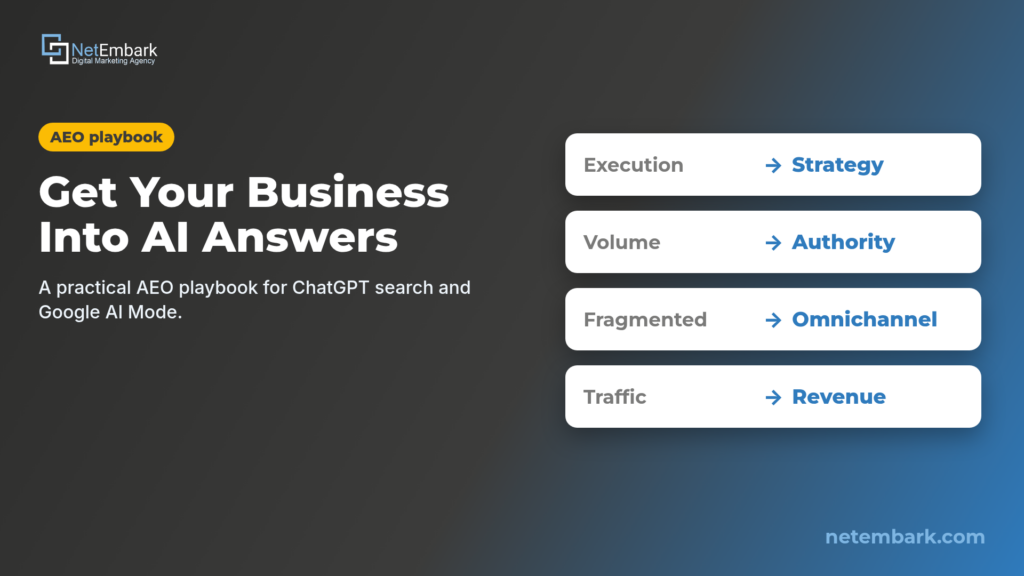
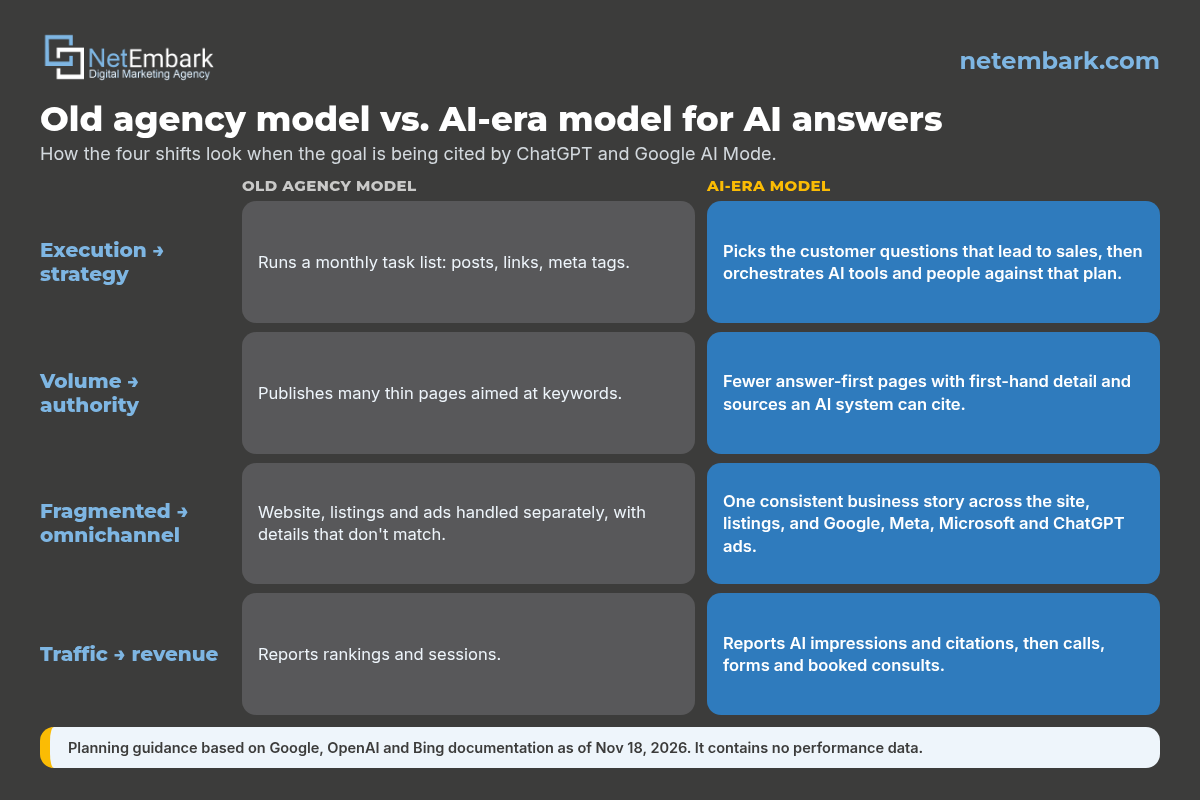
The old agency model treated SEO as a volume and traffic game run from a task list. AI answers pick a handful of sources per question, so the work moves to strategy, authority, one consistent presence across channels, and judging results by leads and revenue.
We describe the four shifts in what an AI-era ad agency does differently. Here’s how each one looks for AI answers:
- Execution to strategy: less time on monthly checklists, more on choosing which customer questions lead to sales and orchestrating AI tools and people to answer them well. AI drafts and checks; people decide and review.
- Volume to authority: fewer, better pages with first-hand detail and sources, because an AI answer cites a few sources, not fifty.
- Fragmented to omnichannel: the website, Business Profile, Bing Places, ChatGPT Business Hub and ads all describe the same business the same way.
- Traffic metrics to revenue metrics: AI impressions and citations are early signals. Calls, forms and booked consults are the result.
Where do paid ads fit next to AEO?
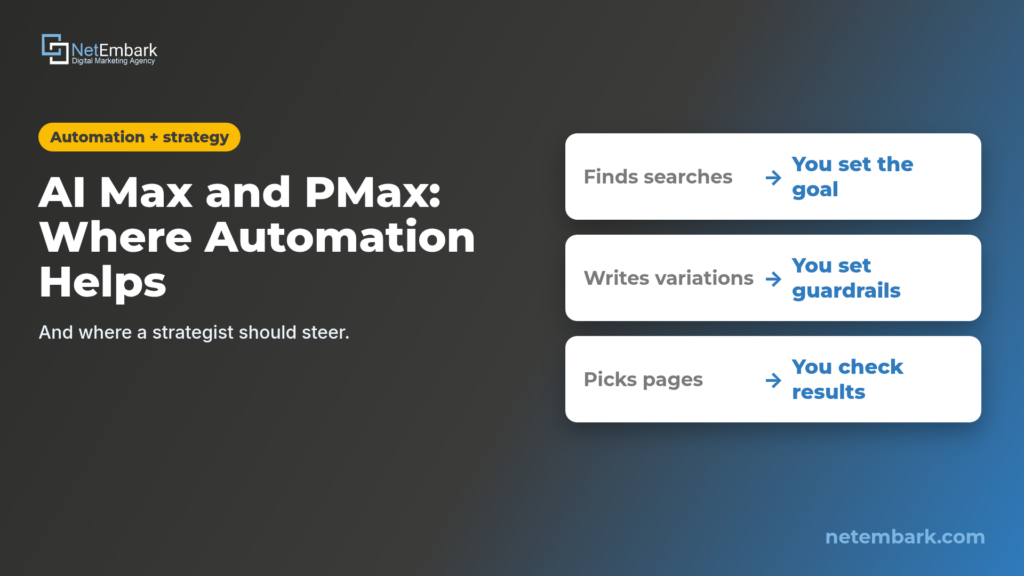
Paid ads and organic AI answers draw on the same pages. Google shows labeled ads in AI Mode, ChatGPT has its own ads, and AI Max writes Search ad copy from your landing pages, so the answer-first pages you build for AEO also feed your ads.
- Google Ads, including AI Max and Performance Max. AI Max text customization “Uses text from your existing ads, landing page copy, and assets along with generative AI” to write ads (Google Ads Help). Clear pages mean more accurate ads. We covered ads in Google’s AI experiences in are Google ads showing in AI Mode and the AI Max decision in should you turn on AI Max. For retailers, Performance Max and Google Shopping rely on accurate Merchant Center data, the same data Google mentions for AI features.
- ChatGPT ads. OpenAI’s OAI-AdsBot visits pages submitted as ads, and OpenAI says it “may also use content from the landing page to determine when it’s most relevant to show the ad” (OpenAI). See what are ChatGPT ads.
- Microsoft Advertising and Meta. Microsoft ads reach Bing and Copilot users (should you run Microsoft Ads alongside Google), and Meta ads reach people before they search (paid social). Planned with Google as one system, they all count the same leads.
Organic AI visibility and paid placements aren’t substitutes. Organic citations can’t be bought; ads give you a labeled spot you control. Most businesses benefit from both, measured against the same lead definition.
How does Netembark help businesses get into AI answers?
We start with an audit of crawl access, indexing and listings, then build answer-first pages around the questions that bring in leads, and report on AI visibility alongside calls, forms and booked consults. People set the strategy and review the work; AI tools help with research, drafting and checks.
- SEO & AEO: robots.txt, CDN and bot-protection checks for Googlebot, OAI-SearchBot and Bingbot; answer-first service and location pages; schema that matches the page; Business Profile and Bing Places clean-up (SEO & AEO services). You can start with a free SEO and AI search audit.
- Web design: fast, mobile-friendly pages with key details in text and lead tracking built in (web design).
- Paid media: Google Ads with AI Max and Performance Max (Google Ads management), plus Meta, Microsoft and ChatGPT ads, planned as one system. Campaigns run on Netembark’s managed ad accounts.
- Reporting: Search Console’s generative AI report, Bing AI Performance and referral visits, tied to calls, forms and booked consultations, with forecasts built using AI-assisted analysis and Google’s planning tools (how AI turns Google Ads data into forecasts).
- Results framing: On average, Netembark’s paid campaigns generate a 12–16% conversion rate (12–18% for medical clients), counting calls, forms and booked consultations. That’s an average across campaigns, not a guarantee.
Related: how to tell if your business shows up in Google’s AI answers, how to claim your business in ChatGPT Business Hub, why 500 AI blog posts won’t help your SEO and the new robots.txt AI-training signal. We’re headquartered at 42 E Main St, Suite 202, Freehold, NJ 07728, with offices in New York and Florida. Learn more about Netembark.
Frequently asked questions
Do you need special schema or an AI text file to appear in Google AI Mode?
No. Google says there are no additional requirements or special optimizations for AI Overviews or AI Mode, and no new AI text files or special schema.org markup are needed. Pages must be indexed and eligible for a snippet, and any structured data should match the visible page.
How do you get your website into ChatGPT search results?
Allow OpenAI's OAI-SearchBot in robots.txt and make sure your host or CDN allows OpenAI's published searchbot IP addresses. OpenAI says ChatGPT ranks results on relevance and reliability and that placement is not guaranteed.
Does blocking GPTBot remove my site from ChatGPT search?
No. OpenAI treats GPTBot, used for model training, and OAI-SearchBot, used for ChatGPT search, as separate settings. You can disallow GPTBot and still allow OAI-SearchBot. Blocking OAI-SearchBot is what removes you from ChatGPT search answers.
How can you tell if your business shows up in Google AI Overviews or AI Mode?
Use the generative AI performance report in Search Console. It shows how often links to your site appeared in AI Overviews and AI Mode, by page, country, device and date. It shows impressions, not leads.
Can you see when Microsoft Copilot cites your website?
Yes. The AI Performance report in Bing Webmaster Tools, launched in public preview in February 2026, shows citations, cited pages and grounding queries across Microsoft Copilot, AI summaries in Bing and select partner integrations.
Does Google Business Profile matter for AI answers?
Yes. Google lists keeping Business Profile and Merchant Center information up to date among its best practices for AI features. Google also says complete, accurate profiles are more likely to show in local results and that reviews and ratings can help local ranking.
Can you pay to appear in ChatGPT or Google AI answers?
Not in the organic answers. Google says indexing and serving aren't guaranteed and there's no way to pay for better local ranking, and OpenAI says ChatGPT placement isn't guaranteed. Paid ads are separate, labeled placements, such as Google ads in AI Mode and ChatGPT ads.
How long does it take to show up in AI answers?
Technical fixes register fairly quickly: OpenAI says robots.txt changes take about 24 hours to reach ChatGPT search. New or rewritten pages take longer, because they need to be crawled, indexed and judged useful before an AI system cites them.
How does Netembark approach AEO?
Netembark audits crawl access, indexing and business listings, builds answer-first pages around the questions that bring in leads, keeps schema matched to each page, and reports AI impressions and citations alongside calls, forms and booked consultations.
Want your business to show up in AI answers? Talk to Netembark, a verified Google Partner and Google Premier Partner 2016–2023. Contact Netembark, email info@netembark.com, or call (800) 707-2697.
How we made this guide: drafted with AI assistance, checked against the Google, OpenAI and Microsoft pages cited below, and reviewed by Netembark before publishing. AI search features change often; this is planning guidance, not a guarantee.
Sources (read November 18, 2026): Google Search Central, AI features and your website. Google Search Central Blog, Top ways to ensure your content performs well in Google’s AI experiences on Search. Google Search Central, Creating helpful, reliable, people-first content. Google Search Central, Spam policies for Google web search. Search Console Help, Generative AI performance report (Search). Google Business Profile Help, Tips to improve your local ranking on Google. Google Ads Help, How AI Max for Search campaigns works. OpenAI Help Center, Searching the web with ChatGPT. OpenAI, Overview of OpenAI crawlers. Bing Webmaster Blog, Introducing AI Performance in Bing Webmaster Tools Public Preview.
Netembark LLC · Verified Google Partner · Google Premier Partner 2016–2023 · 42 E Main St, Suite 202, Freehold, NJ 07728 · (800) 707-2697 · info@netembark.com · @netembark
Want help with your Google Ads?
Book a free strategy call with our verified Google Partner team. We’ll review your account and show you where the leads are.
Gary Pyatigorsky is the founder and CEO of Netembark, a verified Google Partner agency (Google Premier Partner 2016–2023) managing Google Ads, SEO and AEO since 2009.