How Do Google, Meta, Microsoft and ChatGPT Ads Work Together as One System?
November 9, 2026
How Do You Claim Your Business in ChatGPT Business Hub?
November 11, 2026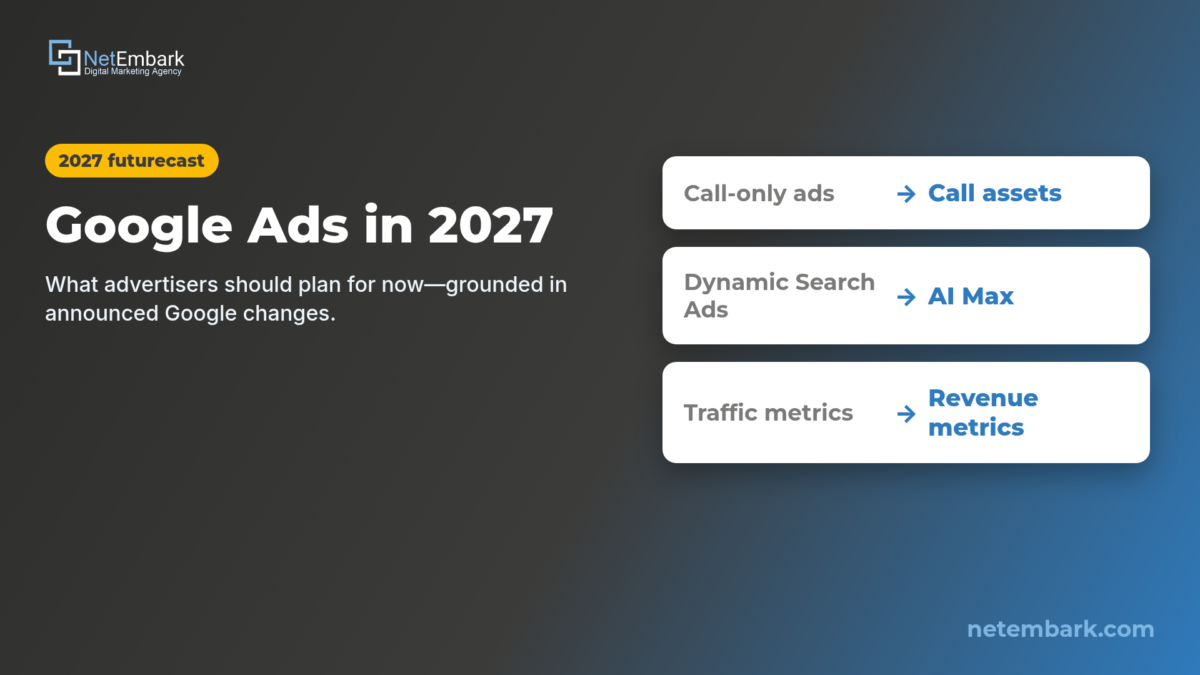
Short answer: In 2027, Google Ads keeps moving toward AI-led matching, creative and bidding—while you steer with goals, brand rules and real lead data. Two hard dates from Google: call-only ads stop receiving impressions in February 2027, and Dynamic Search Ads sunset and auto-upgrade to AI Max begin in February 2027. Our outlook (grounded in Google Help and blog posts, not guarantees): AI Max on Search, ads in AI Overviews and AI Mode, Performance Max with brand controls, and first-party measurement will shape planning. Judge success on calls, forms and booked consultations—not clicks alone.
How will Google Ads change in 2027?
In 2027, Google Ads keeps shifting toward AI-led matching, creative and bidding, while advertisers steer with goals, brand rules and real lead data. Two hard dates: call-only ads stop receiving impressions in February 2027, and Dynamic Search Ads sunset and auto-upgrade to AI Max begin in February 2027. Our outlook—grounded in Google Help and blog posts, not guarantees—is that AI Max, ads in AI Overviews and AI Mode, Performance Max with brand controls, and first-party measurement will shape most plans.
This is a planning guide, not a prediction of auction results. Published dates are dated changes. Shipped-but-still-expanding products are labeled as outlook.
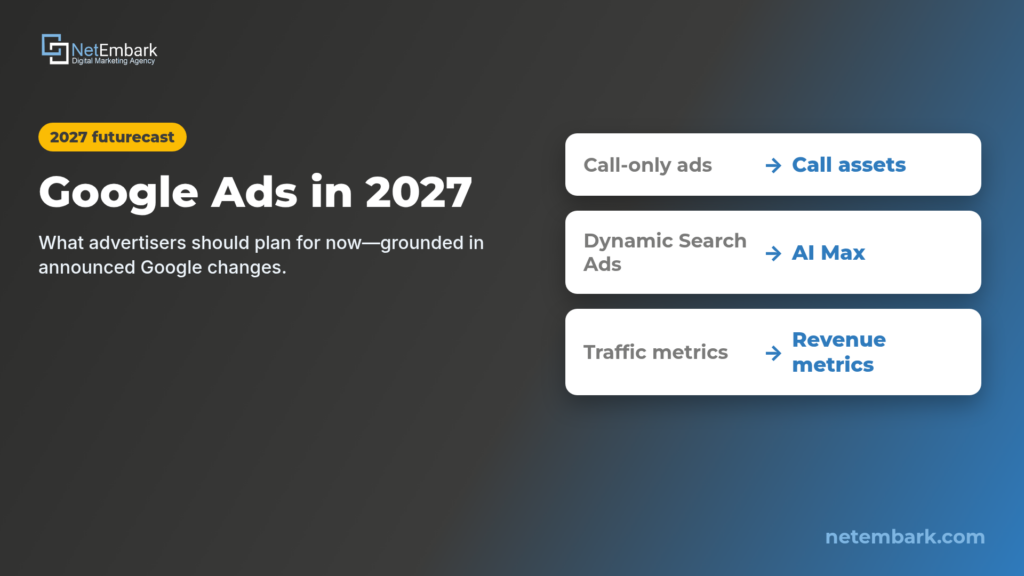
That matches the agency shift in what an AI-era ad agency does differently: execution to strategy, volume to authority, fragmented channels to omnichannel plans, and traffic metrics to revenue metrics (calls, forms and booked consultations).
Video transcript
- How will Google Ads change in 2027? Here's what advertisers should plan for now, grounded in Google's announced product changes.
- First, a hard date. Google says existing call-only ads stop receiving impressions in February 2027. Move to responsive search ads with call assets before then.
- Second, Google is upgrading Dynamic Search Ads to AI Max. The DSA sunset and auto-upgrade begin in February 2027. Review AI Max settings before then.
- Our 2027 outlook: ads in AI Overviews and AI Mode keep mattering. Existing Search, Shopping and Performance Max campaigns can be eligible. Treat AI experiences as Search inventory.
- Performance Max remains Google's goal-based path across YouTube, Display, Search, Discover, Gmail and Maps. Brand and text guidelines steer the AI creative.
- Measurement keeps moving toward first-party data: enhanced conversions, offline imports, Customer Match and Data Manager. Feed Smart Bidding real leads, not just clicks.
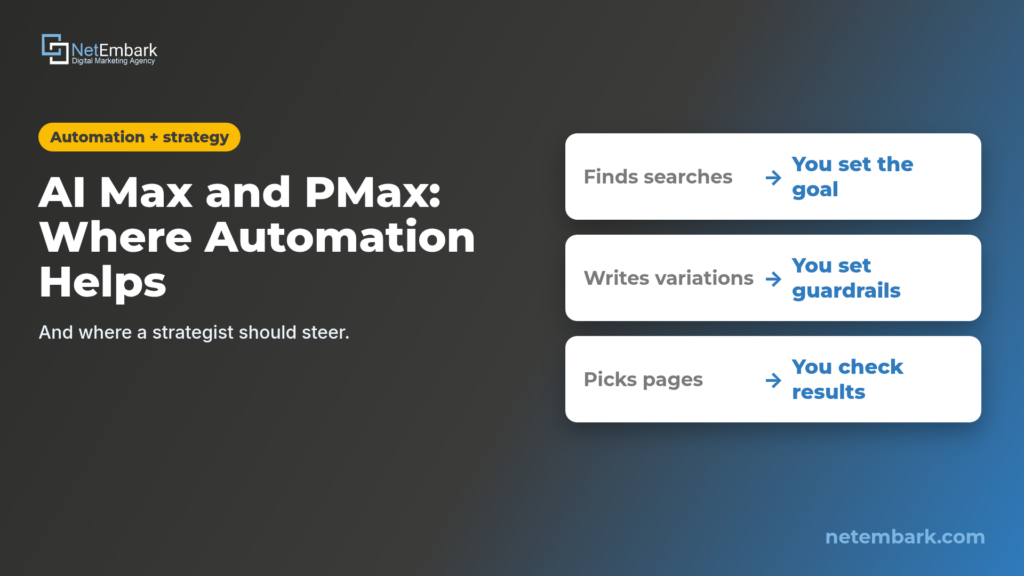
- In 2027, Google AI handles more matching and creative. People still set goals, guardrails, brand rules and what counts as a lead: calls, forms and booked consultations.
- Want a 2027-ready Google Ads plan? Visit netembark.com/contact-us, call 800-707-2697, or email info@netembark.com.
What dated Google Ads changes land in 2027?
Two product timelines already published by Google matter most for early 2027: call-only ads stop serving, and Dynamic Search Ads move to AI Max. Both have February 2027 milestones advertisers should plan around now.
- Call-only ads → call assets: Google’s Help article “Action Required: Transition from call ads to call assets” lists key dates: “February 2026: All options to create a new call-only ad will be removed” and “February 2027: All existing call-only ads will stop receiving impressions.” Google recommends replacing call-only ads with “responsive search ads with call assets” (Google Ads Help: Transition from call ads to call assets; see also how to transition and About call assets).
- Dynamic Search Ads → AI Max: On The Keyword, Google wrote that AI Max for Search campaigns moved out of beta and that legacy features like Dynamic Search Ads would upgrade to AI Max. An update on June 11, 2026 extended the timeline: “we are extending the timeline for Dynamic Search Ads sunset and auto-upgrade, which will begin in February 2027.” Campaigns using Automatically Created Assets and campaign-level broad match setting “will continue to be auto-upgraded starting in September 2026” (Google: We’re upgrading Dynamic Search Ads to AI Max).
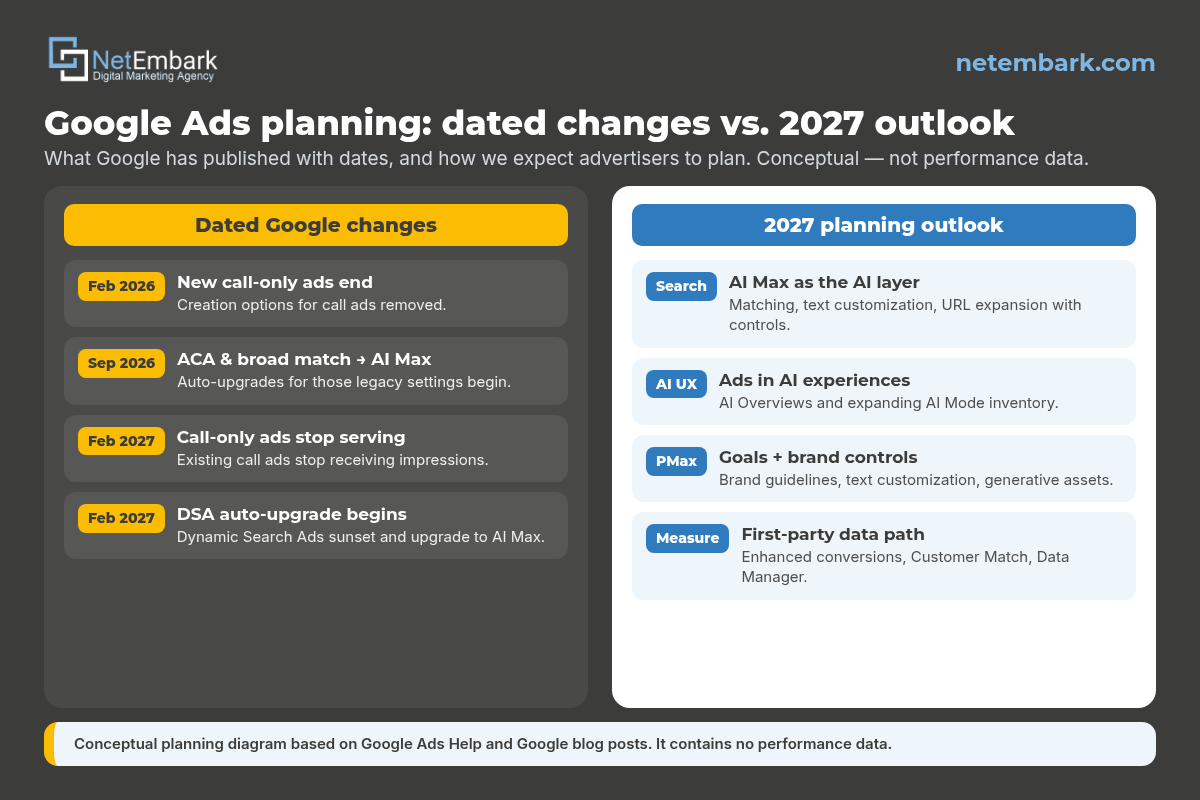
These are calendar items, not performance claims. If you still rely on call-only ads or DSA-style expansion, treat February 2027 as a migration deadline.
How will AI Max shape Google Search campaigns in 2027?
Our outlook: by 2027, AI Max is the default AI layer on Search for most advertisers who still run keyword Search—especially once DSA and related legacy settings have upgraded. Google describes AI Max as a suite of targeting and creative enhancements inside existing Search campaigns, not a separate campaign type.
Google Ads Help says AI Max includes “improved search term matching, better text customization of your headlines and descriptions, and final URL expansion to increase the relevancy of your landing page to a user’s intent,” and notes that new Search campaigns have AI Max turned on by default (About AI Max for Search campaigns; Set up AI Max).
What advertisers should plan for (outlook):
- Controls over autopilot myths. Brand, location and text guidelines steer messaging—review them before auto-upgrades mirror a legacy setup you no longer want.
- Landing pages matter more. Final URL expansion and text customization pull from your site, so thin or contradictory pages become a risk.
- Smart Bidding pairing. Google notes search term matching, final URL expansion and text customization “require conversion-based Smart Bidding strategies in order to function effectively” (Set up AI Max).
More practical detail: Should you turn on AI Max for Google Search campaigns?
Will Google Ads keep showing in AI Overviews and AI Mode in 2027?
Outlook: yes—plan as if ads in AI experiences are normal Search inventory in 2027, not a side experiment. Google already documents ads above, below or within AI Overviews, and it continues to expand ads in AI Mode across markets and formats. Availability and format details can change, so treat expansion as published direction, not a guarantee of share of voice.
- AI Overviews: Google Ads Help states ads are eligible “above, below or within AI Overviews on Search.” Ads above and below are eligible in markets where AI Overviews are available. Ads within AI Overviews are documented for English on mobile and desktop in a listed set of countries, with Text and Shopping ads from existing Search, Shopping and Performance Max campaigns eligible. Google also notes that matching for in-overview ads relies on AI-powered targeting such as broad match or keywordless technology available through AI Max, Performance Max, Shopping or Dynamic Search Ads (About ads and AI Overviews).
- AI Mode expansion: On October 28, 2026, Google announced it was “scaling ads in AI Mode” in Australia, Canada, India, Kenya, Malaysia, New Zealand, Nigeria, Pakistan, the Philippines and Singapore, with plans in Q4 2026 to expand to additional locales including Brazil, Mexico and the United Kingdom, plus multiturn ads in the U.S. Ads remain labeled “Sponsored” (Ads in AI Mode expand to new markets)
- New formats in testing: Google has described testing Gemini-built formats such as Conversational Discovery ads and Highlighted Answers in AI Mode, labeled Sponsored (A new generation of ads for the AI era of Search). Treat them as tests, not guaranteed 2027 inventory.
Practical takeaway: keep Search, Shopping and Performance Max conversion-ready, and build answer-first pages that still make sense when someone arrives from an AI-assisted result. See Are Google Ads showing in AI Mode?
How does Performance Max fit a 2027 Google Ads plan?
Outlook: Performance Max remains Google’s goal-based campaign type for reaching Google inventory from one campaign, while Search (often with AI Max) and brand controls stay important for intent you want to own. Google describes Performance Max as “a goal-based campaign type that allows you to access all Google Ads inventory, including YouTube, Display, Search, Discover, Gmail, and Maps, from a single campaign,” and says it can “complement your keyword-based Search campaigns.” Exact match Search keywords are prioritized over Performance Max when a query matches (About Performance Max campaigns).
- Brand guidelines: Business name and logos are managed as brand guidelines so automated creatives stay on-brand (About brand guidelines).
- Creative AI with guardrails: Text customization, final URL expansion and auto-generated video assets are documented controls inside Performance Max—useful when you supply strong assets and review landing pages (Performance Max Help).
- Complement, don’t replace blindly. For many local and lead-gen advertisers, Search for high-intent queries plus Performance Max for additional inventory is still the planning pattern we expect in 2027. More: Does Performance Max still need a brand Search campaign?
| Older Google Ads habit | 2027 planning posture | |
|---|---|---|
| Campaign layer | Keywords and manual ad variants as the main lever | AI Max and Performance Max as optimization layers, steered by goals and guidelines |
| Call leads | Call-only ads as a separate format | Responsive search ads with call assets (call-only ads stop serving Feb 2027) |
| Search expansion | Dynamic Search Ads and related legacy settings | AI Max: search term matching, text customization, final URL expansion |
| Where ads show | Classic Search results as the default mental model | Search plus AI Overviews and expanding AI Mode inventory |
| Measurement | Clicks and on-site conversions alone | First-party data: enhanced conversions, offline imports, Customer Match |
| Agency work | Execution-heavy: build, bid, report by channel | Strategy-heavy: goals, guardrails, forecasts and revenue outcomes |
How will Google Ads measurement change heading into 2027?
Outlook: the durable measurement path is first-party data—enhanced conversions, offline conversion imports, Customer Match and Google’s Data Manager—paired with consent where required. Google is consolidating enhanced conversions for web and leads and directing offline and enhanced-conversions-for-leads uploads toward the Data Manager API.
- Offline conversions: “By importing offline conversions, you can measure what happens in the offline world after your ad results in a click or call to your business.” Google recommends enhanced conversions for leads for advertisers who have not already adopted offline import (About offline conversion imports).
- Enhanced conversions settings: Help documents that enhanced conversions for web and leads “will soon be combined into a single on/off setting,” that Google Ads will simultaneously accept user-provided data from website tags, Data Manager and API connections, and that starting June 15, 2026, offline conversions import and enhanced conversions for leads uploads migrate to the Data Manager API for many API workflows (Updates to your enhanced conversions settings; also noted on offline conversion imports).
- Customer Match: Customer Match “lets you use your online and offline data to reach and re-engage with your customers across Search, the Shopping tab, Gmail, YouTube, and Display.” Google recommends Data Manager or the Data Manager API for Customer Match workflows going forward (About Customer Match).
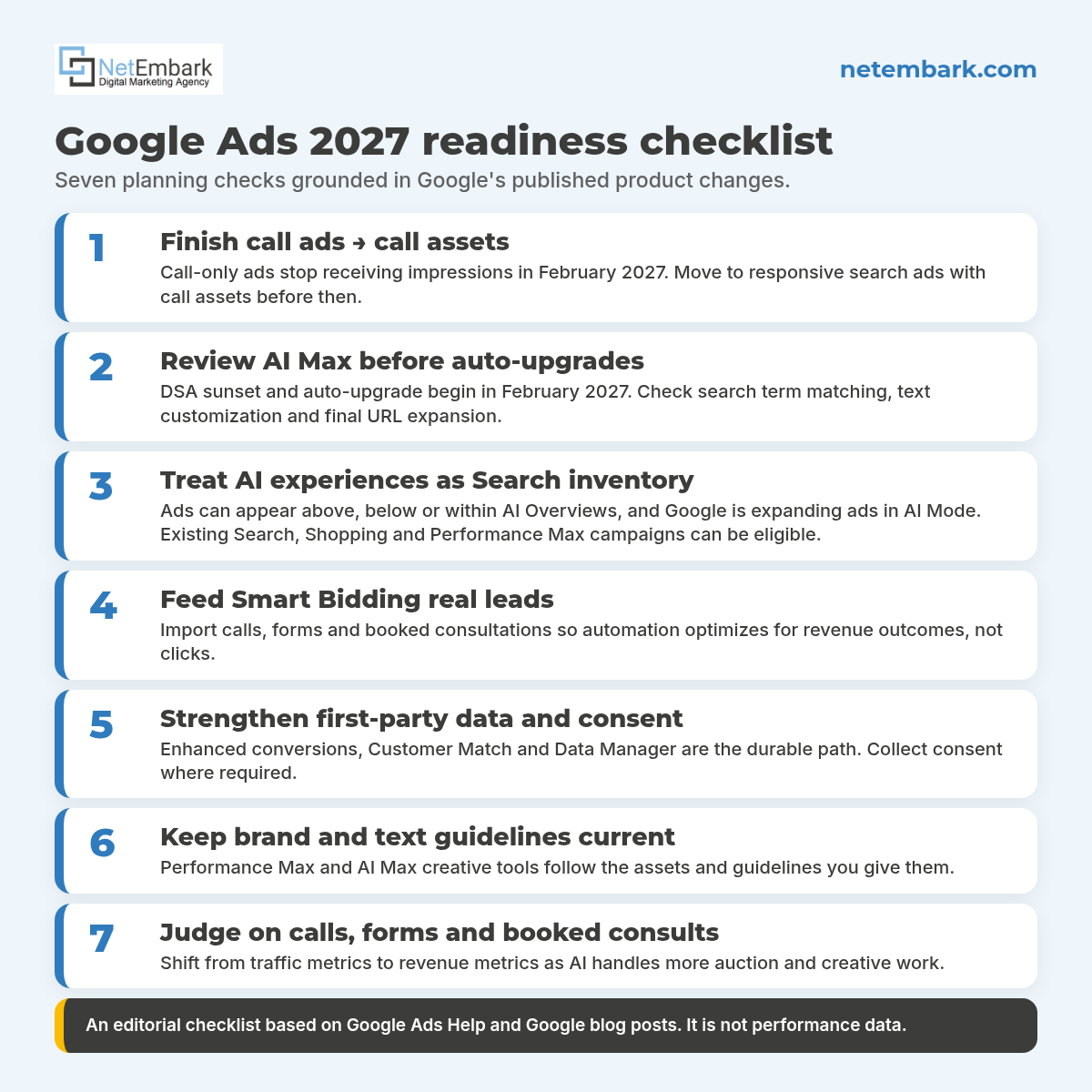
Privacy still applies. Get consent where required. Medical practices need extra care with health data; see our HIPAA-aware conversion tracking guide. Forecasting spend against real leads still matters; see how AI turns Google Ads data into spend and lead forecasts.
Talk to Netembark about a 2027-ready Google Ads plan → · Call (800) 707-2697
What should advertisers plan for in Google Ads before 2027?
Plan around the dated migrations first, then strengthen the data and creative foundations AI Max and Performance Max need. Treat AI Mode and AI Overviews as part of Search reach, and judge success on calls, forms and booked consultations—not clicks alone.
- Migrate call-only ads to responsive search ads with call assets well before February 2027.
- Audit AI Max (and any DSA / Automatically Created Assets / campaign-level broad match setups) so auto-upgrades do not lock in weak URL or text settings.
- Define one lead—call, form or booked consultation—and import those outcomes for Smart Bidding.
- Refresh brand and text guidelines on Performance Max and Search so generative assets stay accurate.
- Invest in answer-first pages that work for classic Search and AI-assisted results (SEO & AEO, web design).
- Connect channels on purpose if you also run Meta, Microsoft or ChatGPT ads—one lead log, budgets moved by results (ads as one system; Microsoft Ads alongside Google; ChatGPT ads).
How does Netembark help companies prepare Google Ads for 2027?
Netembark plans and manages Google Ads—including AI Max and Performance Max—on a strategy-first model: dated migrations handled, Smart Bidding fed real leads, brand guardrails set, and results judged on calls, forms and booked consultations. Campaigns run on Netembark’s managed ad accounts.
- Paid search: Google Ads setup and ongoing management for Search, AI Max and Performance Max (Google Ads and paid search).
- Paid social and adjacent channels: Meta campaigns on the same plan when they fit (paid social); Microsoft and ChatGPT ads where available, coordinated with Google rather than siloed.
- Measurement: conversion tracking aimed at real leads, with care for consent and health-related data where needed.
- Forecasts: AI-assisted analysis and Google planning tools for spend and lead outlooks. Try our budget calculators.
- Results framing: On average, Netembark’s paid campaigns generate a 12–16% conversion rate (12–18% for medical clients). That’s an average across campaigns, not a guarantee.
- Pages that convert: answer-first landing pages from our web design and SEO & AEO teams.
Related: What an AI-era ad agency does differently, AI Max for Search, ads in AI Mode and AI spend and lead forecasts. Netembark is a verified Google Partner (Google Premier Partner 2016–2023), headquartered at 42 E Main St, Suite 202, Freehold, NJ 07728, with offices in New York and Florida. Learn more about Netembark.
Frequently asked questions
How will Google Ads change in 2027?
Google has published hard dates for call-only ads stopping impressions in February 2027 and for Dynamic Search Ads sunset and auto-upgrade to AI Max beginning in February 2027. Our outlook—based on Google Help and blog posts—is that AI Max, ads in AI Overviews and AI Mode, Performance Max with brand controls, and first-party measurement will shape most advertiser plans. Those outlook points are planning guidance, not guarantees.
When do Google call-only ads stop serving?
Google Ads Help says options to create new call-only ads are removed in February 2026, and existing call-only ads stop receiving impressions in February 2027. Google recommends responsive search ads with call assets.
When do Dynamic Search Ads upgrade to AI Max?
Google's Keyword blog (updated June 11, 2026) says the Dynamic Search Ads sunset and auto-upgrade begin in February 2027. Automatically Created Assets and campaign-level broad match auto-upgrades were scheduled to continue starting in September 2026.
What is AI Max for Search campaigns?
AI Max is an optimization layer inside existing Search campaigns—not a new campaign type—with search term matching, text customization and final URL expansion. Google says new Search campaigns have AI Max on by default.
Do Google Ads show in AI Overviews and AI Mode?
Yes, where Google has enabled them. Ads can appear above, below or within AI Overviews under documented rules, and Google continues to expand ads in AI Mode across countries. Formats and markets can change; check current Help for eligibility.
What measurement should advertisers prioritize for 2027?
First-party paths Google documents: enhanced conversions, offline conversion imports, Customer Match and Data Manager—plus consent where required. Feed Smart Bidding calls, forms and booked consultations.
Does AI replace a Google Ads strategist in 2027?
No. Google AI handles more matching, creative and bidding. People still set goals, brand rules, what counts as a lead, and cross-channel budgets.
Should local businesses worry about call-only ads ending?
If you still use call-only ads for phone leads, migrate to call assets on responsive search ads before February 2027.
How does Netembark prepare accounts for these changes?
Netembark manages Google Ads on its managed ad accounts, handles dated migrations, sets AI Max and Performance Max guardrails, and tracks real leads. Contact Netembark for a plan that fits your business.
Ready for a 2027-ready Google Ads plan? Talk to Netembark, a verified Google Partner (Google Premier Partner 2016–2023). Contact Netembark, email info@netembark.com, or call (800) 707-2697.
How we made this guide: drafted with AI assistance, checked against the Google Ads Help and Google blog documentation cited below, and reviewed by Netembark before publishing. Outlook sections are planning guidance based on announced features, not guarantees of future auction results.
Sources (read November 6, 2026): Google Ads Help, Action Required: Transition from call ads to call assets; How to transition from call ads to call assets; About call assets; About AI Max for Search campaigns; Set up AI Max for Search campaigns; About Performance Max campaigns; About brand guidelines; About ads and AI Overviews; About Customer Match; About offline conversion imports; Updates to your enhanced conversions settings. The Keyword / blog.google, We’re upgrading Dynamic Search Ads to AI Max (April 15, 2026; updated June 11, 2026); Ads in AI Mode expand to new markets (October 28, 2026); A new generation of ads for the AI era of Search (May 20, 2026).
Netembark LLC · Verified Google Partner (Google Premier Partner 2016–2023) · 42 E Main St, Suite 202, Freehold, NJ 07728 · (800) 707-2697 · info@netembark.com · @netembark
Want help with your Google Ads?
Book a free strategy call with our verified Google Partner team. We’ll review your account and show you where the leads are.
Gary Pyatigorsky is the founder and CEO of Netembark, a verified Google Partner agency (Google Premier Partner 2016–2023) managing Google Ads, SEO and AEO since 2009.