Do Google Ads Made With AI Need a Disclosure in New York or California?
November 6, 2026
How Will Google Ads Change in 2027?
November 10, 2026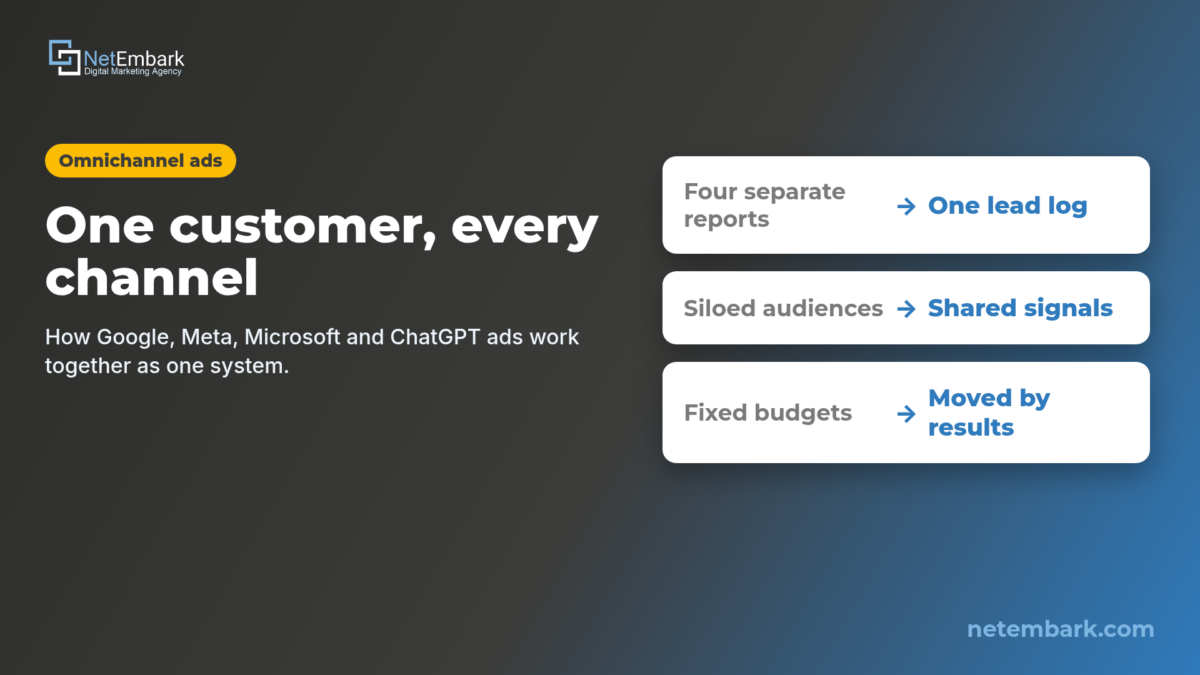
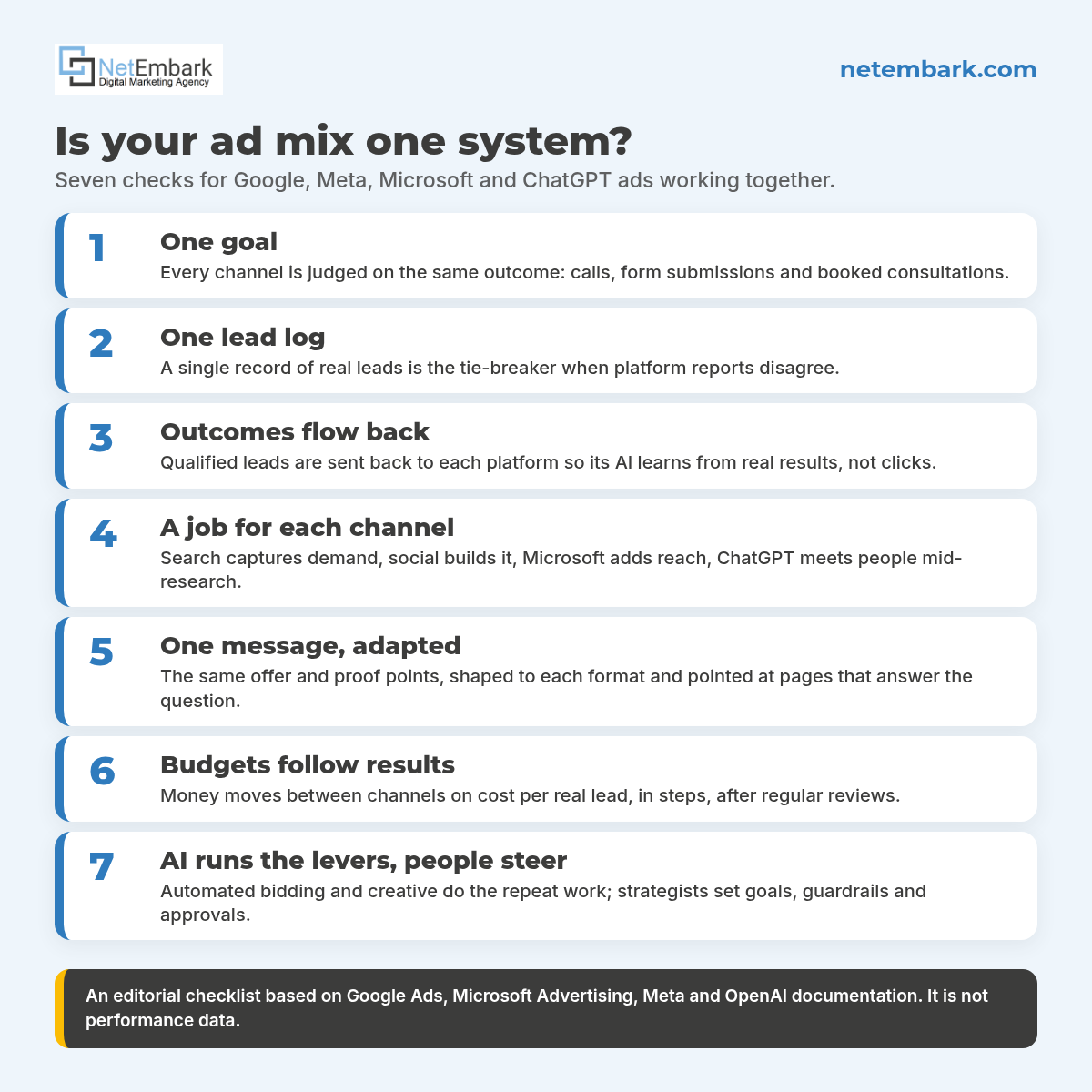
Short answer: Google, Meta, Microsoft and ChatGPT ads work as one system when they share a goal, data and a scoreboard. Define a lead once (a call, form submission or booked consultation), keep one lead log, send those outcomes back to every platform, give each channel a clear job, keep the message consistent, and move budget toward the channel that produces real leads at the best cost. That is omnichannel advertising, and it replaces the old habit of running separate campaigns that each grade their own homework.
How do Google, Meta, Microsoft and ChatGPT ads work together as one system?
They work as one system when every channel chases the same goal, learns from the same real outcomes and is judged in the same report. In practice that means one definition of a lead (a call, form submission or booked consultation), conversion data sent back to every platform, shared audiences and a consistent message, and budgets moved toward whichever channel produces real leads at the best cost.
Your customers don’t think in channels. The same person might search on Google, scroll past your ad on Instagram, use Bing at work and ask ChatGPT to compare options before calling you. Omnichannel advertising treats that as one customer journey, not four separate campaigns.
This is the third of the four shifts we described in what an AI-era ad agency does differently: from fragmented channels, where isolated PPC or social campaigns each have their own report, to omnichannel orchestration, where channels share audiences, creative and measurement and the customer gets a connected experience.
Video transcript
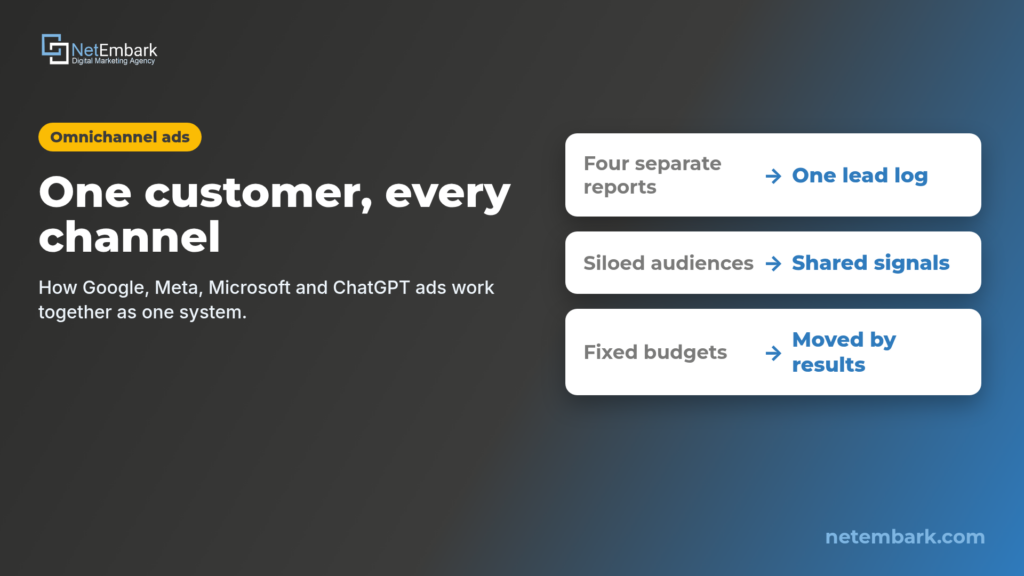
- One customer, every channel. Here's how Google, Meta, Microsoft and ChatGPT ads can work together as one system instead of four separate campaigns.
- The old agency model runs each channel alone: its own audience, its own creative, its own report. Nobody sees the whole customer.
- One system starts with one goal for every channel: real leads, meaning calls, form submissions and booked consultations, not clicks or traffic.
- Then send those real outcomes back to each platform. Google, Microsoft, Meta and ChatGPT ads all offer ways to import conversion data, so each one learns from what actually happened.
- Each channel gets a job. Search captures people already looking, Meta builds demand, Microsoft adds reach, and ChatGPT ads appear below answers while people research.
- Budgets follow results. Compare each channel's cost per real lead from one lead log, then move money in steps instead of leaving fixed splits in place.
- AI handles bidding and creative variations across platforms. People set the goals, guardrails and message, and approve what goes live.
- Want every channel working as one system? Visit netembark.com/contact-us, call 800-707-2697, or email info@netembark.com.
What is the difference between fragmented channels and omnichannel orchestration?
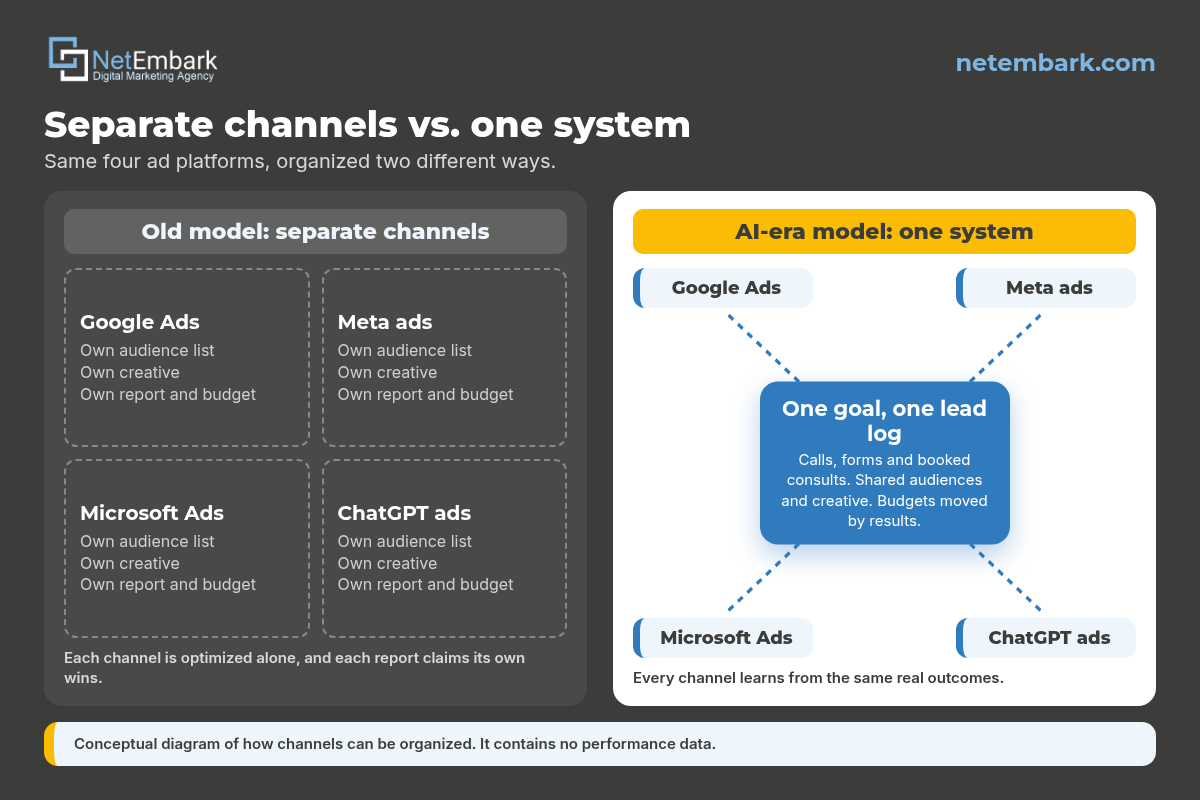
Fragmented channels means each platform is set up, optimized and reported on its own, so nobody sees the whole customer and every report claims credit. Omnichannel orchestration runs the same platforms from one plan with shared goals, audiences, creative and measurement, and moves budget based on real leads rather than each platform’s own numbers.
| Fragmented channels (old model) | Omnichannel orchestration (AI-era model) | |
|---|---|---|
| How channels are run | Separate PPC and social campaigns, often by different people | One plan across Google, Meta, Microsoft and ChatGPT ads |
| Audiences | Each platform builds its own lists | Shared first-party signals and consistent exclusions |
| Creative and message | Rewritten from scratch for each channel | One offer and set of proof points, adapted to each format |
| Measurement | A separate report per platform, each claiming its own wins | One lead log of calls, forms and booked consultations |
| Budget | Fixed monthly split per channel | Moved between channels by cost per real lead |
| Role of AI | Point tools inside each platform | Platform AI fed real outcomes; strategists set goals and guardrails |
A common sign of the old model: add up the conversions each platform reports and the total is higher than the leads your front desk actually logged. Each platform counts by its own attribution rules. Microsoft, for example, notes that Google Ads conversion goals using data-driven attribution are imported with last-click attribution (Microsoft Advertising). One lead log you control is the fair way to compare them.
What job does each ad channel do in an omnichannel system?
Google Search and Performance Max capture people who are already looking, Meta builds demand with people who aren’t searching yet, Microsoft Advertising extends Search reach and can start from your Google setup, and ChatGPT ads reach people while they research in a conversation. Each job matters, but none should be judged alone.
- Google Ads: Google describes Performance Max as “a goal-based campaign type that allows you to access all Google Ads inventory, including YouTube, Display, Search, Discover, Gmail, and Maps, from a single campaign,” and says it can “complement your keyword-based Search campaigns.” Search campaigns with an exact match keyword are prioritized over Performance Max when a query matches that keyword (Google Ads Help: About Performance Max). See our posts on PMax and brand Search and AI Max for Search.
- Meta (Facebook and Instagram): paid social reaches people by interest and audience rather than by search query, which makes it useful for building demand and retargeting. Meta’s Conversions API is “designed to create a direct and more reliable connection between marketing data (from your server, website platform, app or CRM) and Meta,” and that data “includes website events, app events, offline conversions and messaging events” (Meta Business Help: About Conversions API).
- Microsoft Advertising: you can import Google Ads campaigns, and Microsoft imports Google Performance Max campaigns “as Performance Max or Search campaigns.” It also warns that “not all information will be imported,” so imported campaigns need a review (Microsoft Learn: What gets imported from Google Ads). More in should you run Microsoft Ads alongside Google?
- ChatGPT ads: OpenAI says users “may see ads below a ChatGPT response,” that ads may appear for Free and Go plan users, and that “Ads do not influence ChatGPT’s answers.” Its ads system “selects and delivers ads based on expected relevance and outcomes,” using signals such as the conversation’s context and the ad’s landing page (OpenAI Help: Ads in ChatGPT). Availability varies by country. More in what are ChatGPT ads?
Our read: the ChatGPT detail about landing pages is a reminder that the page behind the ad matters on every channel. A clear, answer-first page can serve Google, Meta, Microsoft and ChatGPT ads at once, so the customer hears the same message wherever they meet you.
What does shared measurement look like across ad platforms?
Shared measurement means deciding once what counts as a lead, keeping one lead log, and sending those real outcomes back to each platform so its automation optimizes for leads instead of clicks. All four platforms now offer a way to receive conversion data from outside their own tag.
- Google Ads: “By importing offline conversions, you can measure what happens in the offline world after your ad results in a click or call to your business.” Google recommends enhanced conversions for leads for new setups (Google Ads Help: About offline conversion imports). Customer Match “lets you use your online and offline data to reach and re-engage with your customers across Search, the Shopping tab, Gmail, YouTube, and Display” (Google Ads Help: About Customer Match).
- Microsoft Advertising: its Conversions API “enables advertisers to send conversion and engagement events directly from their servers using Universal Event Tracking (UET).” Microsoft notes not every account has it yet (Microsoft Learn: About the Conversions API).
- Meta: the Conversions API accepts offline conversions alongside website, app and messaging events (Meta).
- ChatGPT ads: OpenAI says its measurement approach supports “both in-house and partner-led measurement solutions,” with integrations that “make it easier for advertisers to send conversion data from their existing systems to ChatGPT Ads” (OpenAI, October 5, 2026). Its help center adds that advertisers receive aggregated reporting such as views and clicks, not users’ chats.
Privacy rules still apply to every upload. Get consent where required, and medical practices need extra care with health data; see our HIPAA-aware conversion tracking guide.
How should ad budgets move between Google, Meta, Microsoft and ChatGPT?
Budgets should follow results, not habit. Review each channel’s cost per real lead from your own lead log on a regular schedule, move money in steps toward what’s working, keep a small share for testing newer channels, and give each change enough time for the platform’s automation to adjust before judging it.
- Start from the lead log, not the dashboards. Platform reports are useful for optimizing inside each channel, but the cross-channel decision should use the same lead count for everyone.
- Remember the assist. A Meta or ChatGPT ad may start a journey that ends in a branded Google search. Watch branded search and direct calls when you change upper-funnel spend.
- Move in steps. Large overnight swings make it hard to tell what caused a change and can disrupt automated bidding while it relearns.
- Forecast before you shift. Google’s planning tools and AI-assisted analysis can estimate what more or less spend might do; see how AI turns Google Ads data into spend and lead forecasts.
Talk to Netembark about running your ad channels as one system → · Call (800) 707-2697
Where do AI and people fit in running every channel as one system?
AI does the repeat work inside each platform, bidding, matching and creative variations, while people decide the goal, the message, the guardrails and where the money goes. That’s the shift from execution to strategy, and from traffic metrics to revenue metrics.
- Execution to strategy: each platform’s automation is strong at its own auction. Someone still has to make the four work together, set exclusions and approve what goes live. AI agents can help with reporting and checks; see AI agents in your marketing: what to automate.
- Traffic to revenue: automation optimizes for whatever signal you give it. Feed it clicks and it finds clicks. Feed it calls, forms and booked consultations and it has a better target.
- Authority pages behind the ads: the same answer-first pages that help in SEO and AEO make better landing pages for every channel.
How does Netembark help companies run Google, Meta, Microsoft and ChatGPT ads as one system?
Netembark plans and manages all four channels from one strategy, uses AI-assisted analysis to speed up the work, and puts strategists on the decisions: one lead goal, shared measurement, a consistent message and budgets moved by results.
- Paid search: Google Ads, including AI Max and Performance Max, plus Microsoft Advertising (Google Ads and paid search).
- Paid social: Meta campaigns on Facebook and Instagram run on the same plan (paid social).
- ChatGPT ads: Netembark runs ChatGPT ads for clients where the format is available and fits the business.
- One view of the data: campaigns run on Netembark’s managed ad accounts, with tracking set up around calls, forms and booked consultations. On average, Netembark’s paid campaigns generate a 12–16% conversion rate (12–18% for medical clients). That’s an average across campaigns, not a guarantee.
- Forecasts and budgets: AI-assisted analysis and Google’s planning tools for spend and lead forecasts. Try our budget calculators.
- Pages that convert: answer-first landing pages and sites from our web design and SEO & AEO teams.
Related: What an AI-era ad agency does differently, Microsoft Ads alongside Google, What are ChatGPT ads?, Can customers book home services from Google AI Mode? and Do Google ads made with AI need a disclosure in New York or California? Netembark is a verified Google Partner (Google Premier Partner 2016–2023), headquartered at 42 E Main St, Suite 202, Freehold, NJ 07728, with offices in New York and Florida. Learn more about Netembark.
Frequently asked questions
What is omnichannel advertising?
Running several ad channels, such as Google, Meta, Microsoft and ChatGPT ads, from one plan with shared goals, audiences, creative and measurement, so a customer gets a connected experience and budgets move based on real leads rather than each platform's own report.
Do I need to advertise on Google, Meta, Microsoft and ChatGPT at the same time?
Not necessarily. Start where your customers already look for what you sell, get lead tracking in place, then add channels you can measure. A smaller mix run as one system usually beats four channels run separately.
Why don't my ad platform reports add up to my real leads?
Each platform counts conversions by its own attribution rules, so the same lead can be claimed by more than one platform. Keep one lead log of calls, forms and booked consultations and compare channels against it.
Can I copy my Google Ads campaigns to Microsoft Advertising?
Yes. Microsoft Advertising can import Google Ads campaigns, including Performance Max campaigns as Performance Max or Search campaigns. Microsoft says not all information is imported, so review imported campaigns before relying on them.
Where do ChatGPT ads appear?
OpenAI says ads may appear below a ChatGPT response for users on the Free and Go plans, are clearly labeled, and do not influence ChatGPT's answers. Advertiser availability varies by country.
What conversion data should I send back to ad platforms?
Your real outcomes: calls, form submissions and booked consultations, and later steps like signed jobs if you track them. Google offers offline conversion imports and enhanced conversions for leads, Microsoft and Meta offer Conversions APIs, and OpenAI supports conversion data integrations for ChatGPT ads.
How often should budgets move between channels?
On a regular review schedule once each channel has enough lead data to judge, in steps rather than big swings, so automated bidding can adjust and you can see what caused a change.
Does AI replace the strategist in multi-channel advertising?
No. Each platform's AI optimizes its own auction. People still set the shared goal, the message, the guardrails and the budget moves across channels, and approve what goes live.
Ready to run Google, Meta, Microsoft and ChatGPT ads as one system? Talk to Netembark, a verified Google Partner (Google Premier Partner 2016–2023). Contact Netembark, email info@netembark.com, or call (800) 707-2697.
How we made this guide: drafted with AI assistance, checked against the Google, Microsoft, Meta and OpenAI documentation cited below, and reviewed by Netembark before publishing.
Sources (read November 5, 2026): Google Ads Help, About Performance Max campaigns; About Customer Match; About offline conversion imports. Microsoft Learn, What gets imported from Google Ads; Where can I find information about the Conversions API (CAPI)?. Meta Business Help Center, About Conversions API. OpenAI Help Center, Ads in ChatGPT; OpenAI, Building advertising for the way people use AI (October 5, 2026).
Netembark LLC · Verified Google Partner (Google Premier Partner 2016–2023) · 42 E Main St, Suite 202, Freehold, NJ 07728 · (800) 707-2697 · info@netembark.com · @netembark
Want help with your Google Ads?
Book a free strategy call with our verified Google Partner team. We’ll review your account and show you where the leads are.
Gary Pyatigorsky is the founder and CEO of Netembark, a verified Google Partner agency (Google Premier Partner 2016–2023) managing Google Ads, SEO and AEO since 2009.