Google Ads Consultant or Agency? What New Jersey Businesses Should Look For
November 5, 2026
Can Customers Book My Home Service Company From Google AI Mode?
November 5, 2026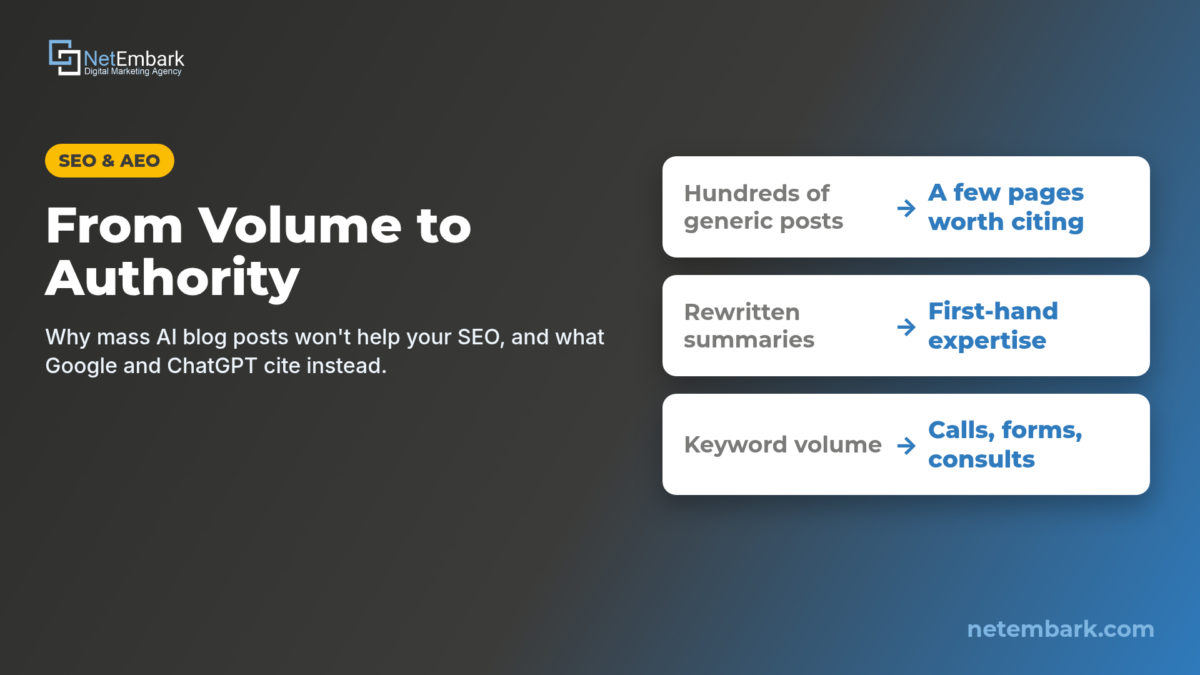
Short answer: Publishing hundreds of AI-written posts won’t help your SEO on its own. Google’s spam policies treat generating many pages without adding value as scaled content abuse, and Google says AI gives content no special ranking gains. Google’s AI features and ChatGPT search both point back to indexed, crawlable pages that answer questions reliably. What earns citations is authority content: fewer, deeper pages built on first-hand expertise, your own data and useful tools, with sources and a real author or team behind them.
Will publishing hundreds of AI blog posts help your SEO?
Not by itself, and it can hurt. Google’s spam policies call it scaled content abuse when many pages are generated mainly to manipulate rankings rather than help users, and they list “using generative AI tools or other similar tools to generate many pages without adding value for users” as an example. Volume without value is the problem, not AI.
Google defines scaled content abuse as “when many pages are generated for the primary purpose of manipulating search rankings and not helping users,” and adds that this is “typically focused on creating large amounts of unoriginal content that provides little to no value to users, no matter how it’s created” (Google spam policies). Sites that violate the spam policies “may rank lower in results or not appear in results at all.”
Google’s own self-assessment questions read like a description of the volume play. Among the warning signs it lists: “Are you producing lots of content on many different topics in hopes that some of it might perform well in search results?” and “Are you using extensive automation to produce content on many topics?” It also asks whether you’re writing to a particular word count because you’ve heard Google prefers one. Google’s answer: “No, we don’t” (Creating helpful, reliable, people-first content).
None of this means AI is off limits. Google says “appropriate use of AI or automation is not against our guidelines,” and also: “Using AI doesn’t give content any special gains. It’s just content” (Google Search Central blog).
Video transcript
- Five hundred AI blog posts won't save your SEO. Here's the difference between volume content and the authority content Google and ChatGPT cite.
- Google's spam policies name it scaled content abuse: generating many pages to manipulate rankings without adding value for users, however they're made.
- AI itself isn't banned. Google says appropriate use of AI is fine, and that using AI gives content no special gains. It's just content.
- To appear in AI Overviews and AI Mode, Google says there are no extra requirements: a page must be indexed and eligible to show with a snippet, and SEO fundamentals still apply.
- ChatGPT search answers can include citations. OpenAI says it ranks results to help users find relevant, reliable information, and sites should allow OAI-SearchBot to crawl.
- Authority content is what only you can say: first-hand expertise, your own data and examples, and useful tools, from a real author or team.
- Use AI for research and structure, then have a person add the expertise and fact-check every claim before it goes live.
- Want content that Google and AI answers can trust? Visit netembark.com/contact-us, call 800-707-2697, or email info@netembark.com.
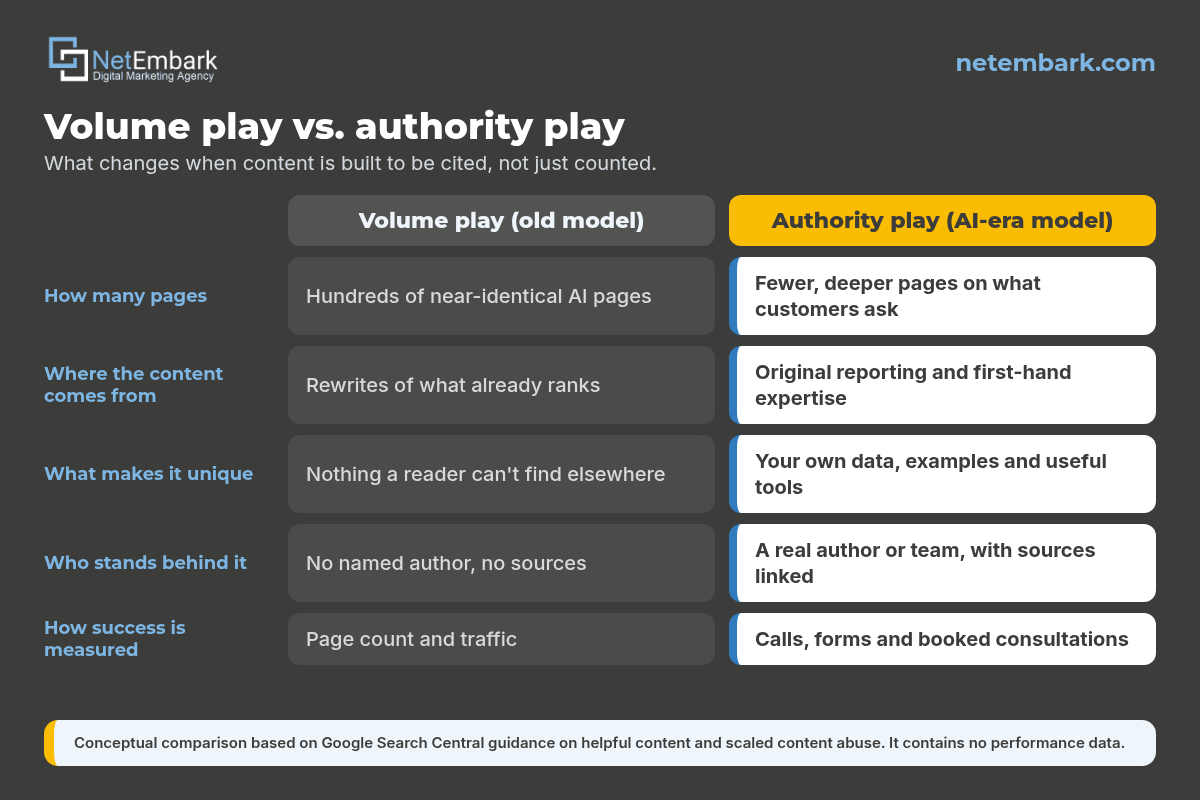
What is the difference between volume SEO and authority content?
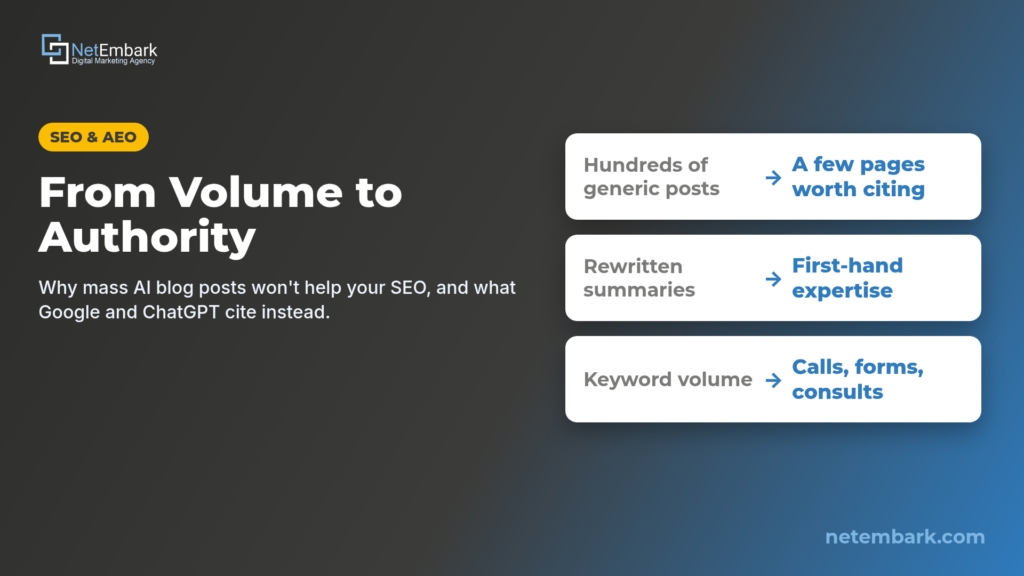
Volume SEO tries to win by publishing as many keyword-targeted pages as possible. Authority content wins by publishing fewer, deeper pages built on things only your business can offer: first-hand expertise, original reporting, your own data and genuinely useful tools, from a real author or team, with sources linked.
| Volume play (old model) | Authority play (AI-era model) | |
|---|---|---|
| What gets published | As many keyword-targeted articles as possible | Fewer, deeper pages on the questions customers actually ask |
| Where the substance comes from | Rewriting what already ranks | First-hand expertise, original reporting and your own data |
| Role of AI | Writes the whole page, nobody checks | Speeds up research and structure; a person adds expertise and fact-checks |
| Who stands behind it | No author, no sources | A real author or team, sources linked, an About page |
| What it’s built to do | Rank for a keyword | Answer a question well enough to be read, trusted and cited |
| How success is measured | Page count, impressions, traffic | Calls, form submissions and booked consultations |
This is the second of the four shifts we described in what an AI-era ad agency does differently: from a volume play of generic, high-volume articles to an authority play built on deep reporting, proprietary research and unique brand experiences. Google’s questions point the same way. It asks whether content provides “original information, reporting, research, or analysis” and “insightful analysis or interesting information that is beyond the obvious,” and whether it’s “mass-produced by or outsourced to a large number of creators” so that pages don’t get much care (Google).
What do Google's AI features and ChatGPT search actually cite?
Both point back to the same basics. Google says pages need no special optimization for AI Overviews or AI Mode, only to be indexed and eligible to show with a snippet, plus normal SEO best practices. OpenAI says ChatGPT search ranks results to help people find relevant, reliable information and that sites should allow OAI-SearchBot to crawl.
- Google AI Overviews and AI Mode: “There are no additional requirements to appear in AI Overviews or AI Mode, nor other special optimizations necessary.” To be a supporting link, a page “must be indexed and eligible to be shown in Google Search with a snippet.” Google also says you don’t need “new machine readable files, AI text files, or markup,” and that your structured data should match the visible text on the page (AI features and your website).
- Query fan-out: Google says both features may issue “multiple related searches across subtopics and data sources” to build a response, which lets them show “a wider and more diverse set of helpful links” than a classic search (Google). A page that answers one specific question well has a clear job in that kind of answer.
- ChatGPT search: Responses that use web search “may include citations.” OpenAI says ChatGPT “ranks search results using multiple factors intended to help users find relevant, reliable information,” notes that placement isn’t assured, and says that to be eligible a site should allow OAI-SearchBot to crawl and make sure its host or CDN allows OpenAI’s published IP addresses (Searching the web with ChatGPT).
- Search vs. training: OpenAI treats OAI-SearchBot (search) and GPTBot (model training) as separate settings, so a site can allow one and block the other. Sites opted out of OAI-SearchBot “will not be shown in ChatGPT search answers,” though they can still appear as navigational links (Overview of OpenAI crawlers).
Our read: neither company publishes a formula for being cited, but both describe the same target. If your page says the same thing as hundreds of others, there’s little reason for an answer engine to pick yours. If it carries first-hand detail, clear answers and sources, it gives them one.
What does authority content look like for a local or mid-size business?
You don’t need a newsroom. Authority content for a business is usually one of three things: reporting from your own work, research from your own data, or a useful experience only your brand offers, each written or reviewed by someone who knows the subject and answers a real customer question first.
- Deep reporting from your own work: what your team sees on real jobs, explained by the person who did the work. Google’s people-first questions ask whether content shows “first-hand expertise and a depth of knowledge.”
- Proprietary research: patterns from your own records or a survey of your own customers, with an explanation of how you gathered it. Google suggests sharing the “How” behind content so readers can judge it.
- Unique brand experiences: tools, calculators, short videos and checklists that help someone decide. Google counts interactive features like calculators as part of a page’s main content. Our own Google Ads budget calculator is an example of this kind of page.
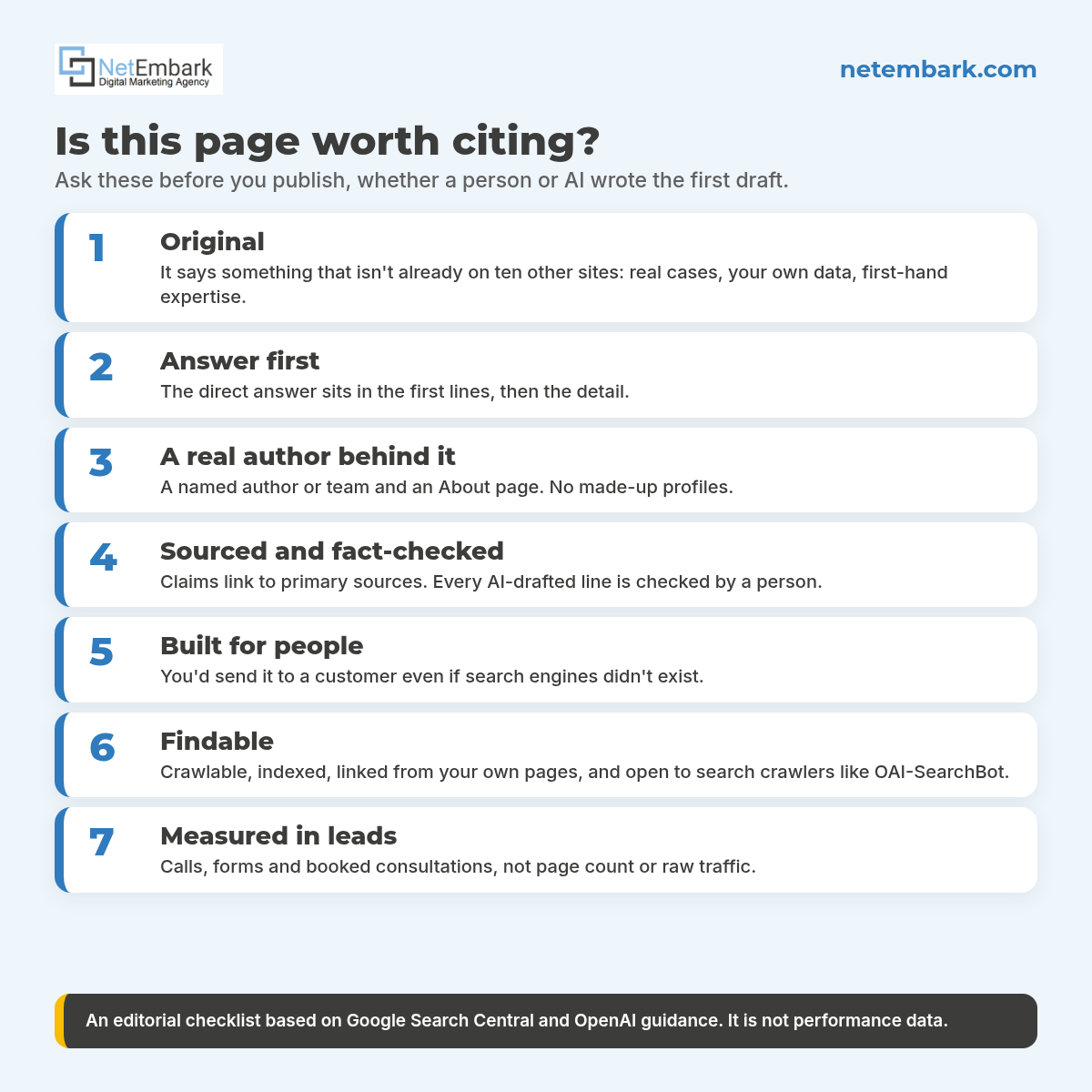
Credibility signals matter too. Google encourages accurate bylines and author information, and warns that fabricated creator profiles, such as “AI-generated headshots, made-up names, or false credentials,” are deceptive and a signal of a low-quality page (Google).
Talk to Netembark about an authority content plan for Google and AI answers → · Call (800) 707-2697
How should you use AI in content without publishing AI slop?
Use AI where it is strong, research, outlines and structure, and keep people responsible for substance and accuracy. Google says generative AI can help research a topic and add structure to original content, but it is “critical to manually factcheck and review all AI-generated content” before publishing.
- Fact-check everything: Google notes that generative models “don’t retrieve facts, but predict a likely sequence of words,” so outputs can contain inaccuracies. The review should also cover titles, meta descriptions, structured data and image alt text (Google’s guidance on generative AI content).
- Add what AI can’t: your examples, your numbers, your judgment. Google’s raters look at effort and originality, and Google notes that “attribution or giving credit to other sources doesn’t replace the need for original effort” (Google).
- Be open about how it was made: Google suggests AI or automation disclosures where a reader might reasonably ask “How was this created?” (Google).
- Don’t flood or purge for “freshness”: Google says adding or removing lots of content just to look fresh won’t help rankings. If you’re hosting scaled, low-value pages, Google’s guidance is to exclude them from Search, so review old pages one by one: improve, combine or remove from the index.
For a wider look at where AI belongs in marketing, see AI agents in your marketing: what to automate.
How does authority content fit the shift to an AI-era agency?
It’s one of four connected shifts. AI takes over repeat work so strategists can decide what’s worth publishing, the same authority pages support organic search, AI answers and paid campaigns across channels, and success is measured in leads rather than traffic.
- Execution to strategy: AI speeds up drafting and research; people choose the questions worth answering and approve what goes live.
- Volume to authority: fewer, deeper pages that search engines and AI answers have a reason to cite.
- Fragmented to omnichannel: a strong answer page can also serve as a landing page for Google Ads, Microsoft, Meta and ChatGPT ads, so the message is consistent wherever a customer meets you.
- Traffic to revenue: the score is calls, form submissions and booked consultations, not pageviews.
How does Netembark help companies build authority content for Google and AI answers?
Netembark uses AI to speed up research and production, then puts strategists and subject experts on what matters: picking the questions your customers ask, building answer-first pages with real expertise and sources, keeping them crawlable for Google and ChatGPT, and tying them to leads.
- SEO and AEO: answer-first content, FAQ and structured data that match the visible copy, and technical checks so Google and OAI-SearchBot can crawl the site (SEO & AEO services).
- Web design: fast, conversion-ready pages where useful tools, video and clear calls to action live (web design).
- Paid media on the same plan: Google Ads, including AI Max and Performance Max, plus Microsoft, Meta and ChatGPT ads, pointed at the same authority pages (paid advertising).
- Measured in leads: tracking is set up around calls, forms and booked consultations. On average, Netembark’s paid campaigns generate a 12–16% conversion rate (12–18% for medical clients). That’s an average across campaigns, not a guarantee.
- A person approves every page: AI-assisted drafts are fact-checked and reviewed before they’re published.
Related: What an AI-era ad agency does differently, AI agents in your marketing: what to automate, Should your site use the robots.txt AI training signal? and How AI turns Google Ads data into spend and lead forecasts. Netembark is a verified Google Partner (Google Premier Partner 2016–2023), headquartered at 42 E Main St, Suite 202, Freehold, NJ 07728, with offices in New York and Florida. Learn more about Netembark.
Frequently asked questions
Does Google penalize AI-generated content?
Not for being AI-generated. Google says appropriate use of AI or automation is not against its guidelines. Using automation, including AI, to generate content primarily to manipulate search rankings violates its spam policies, and using AI gives content no special ranking gains.
What is scaled content abuse?
Google's spam policy term for generating many pages primarily to manipulate search rankings rather than help users, typically large amounts of unoriginal content with little value, no matter how it is created. Mass AI pages that add no value are one of Google's listed examples.
How many blog posts should a business publish?
There is no magic number. Google says it has no preferred word count and lists producing lots of content on many topics in hopes some of it ranks as a warning sign. Publish when you have something original and useful to say.
Do I need an llms.txt file or special schema to appear in Google's AI Overviews?
No. Google says there are no additional requirements or special optimizations for AI Overviews or AI Mode, and you don't need new machine-readable files, AI text files or special schema. Pages must be indexed and eligible to show with a snippet, and structured data should match the visible text.
How does ChatGPT decide which sources to cite?
OpenAI says ChatGPT search ranks results using multiple factors intended to help users find relevant, reliable information, and placement isn't assured. To be eligible, a site should allow OAI-SearchBot to crawl and allow OpenAI's published IP addresses.
What is authority content?
Content built on what only your business can offer: first-hand expertise, original reporting, your own data or useful tools, from a real author or team, with sources linked and the answer up front.
Can I still use AI to write blog posts?
Yes, with care. Google says generative AI can help with research and structure, but all AI-generated content should be manually fact-checked and reviewed before publishing, including titles, meta descriptions, structured data and alt text.
Should I delete my old AI-generated posts?
Review them one by one rather than mass-deleting. Google says removing lots of older content just to seem fresh won't help rankings, but if pages are scaled, low-value content, its guidance is to exclude them from Search. Improve, combine or remove from the index as each page warrants.
Ready to trade content volume for content that Google and AI answers can trust? Talk to Netembark, a verified Google Partner (Google Premier Partner 2016–2023). Contact Netembark, email info@netembark.com, or call (800) 707-2697.
How we made this guide: drafted with AI assistance, checked against the Google and OpenAI documentation cited below, and reviewed by Netembark before publishing.
Sources (read November 4, 2026): Google Search Central, Spam policies for Google web search: scaled content abuse; Creating helpful, reliable, people-first content; Google Search’s guidance on using generative AI content on your website; Google Search’s guidance about AI-generated content (February 8, 2023); AI features and your website. OpenAI, Searching the web with ChatGPT; Overview of OpenAI crawlers.
Netembark LLC · Verified Google Partner (Google Premier Partner 2016–2023) · 42 E Main St, Suite 202, Freehold, NJ 07728 · (800) 707-2697 · info@netembark.com · @netembark
Want help with your Google Ads?
Book a free strategy call with our verified Google Partner team. We’ll review your account and show you where the leads are.

Gary Pyatigorsky is the founder and CEO of Netembark, a verified Google Partner agency (Google Premier Partner 2016–2023) managing Google Ads, SEO and AEO since 2009.