Google Ads Agency for Brands: What to Look For and What Good Looks Like
November 2, 2026
ChatGPT Ads vs. Google Search Ads: What the First Revenue Study Found
November 3, 2026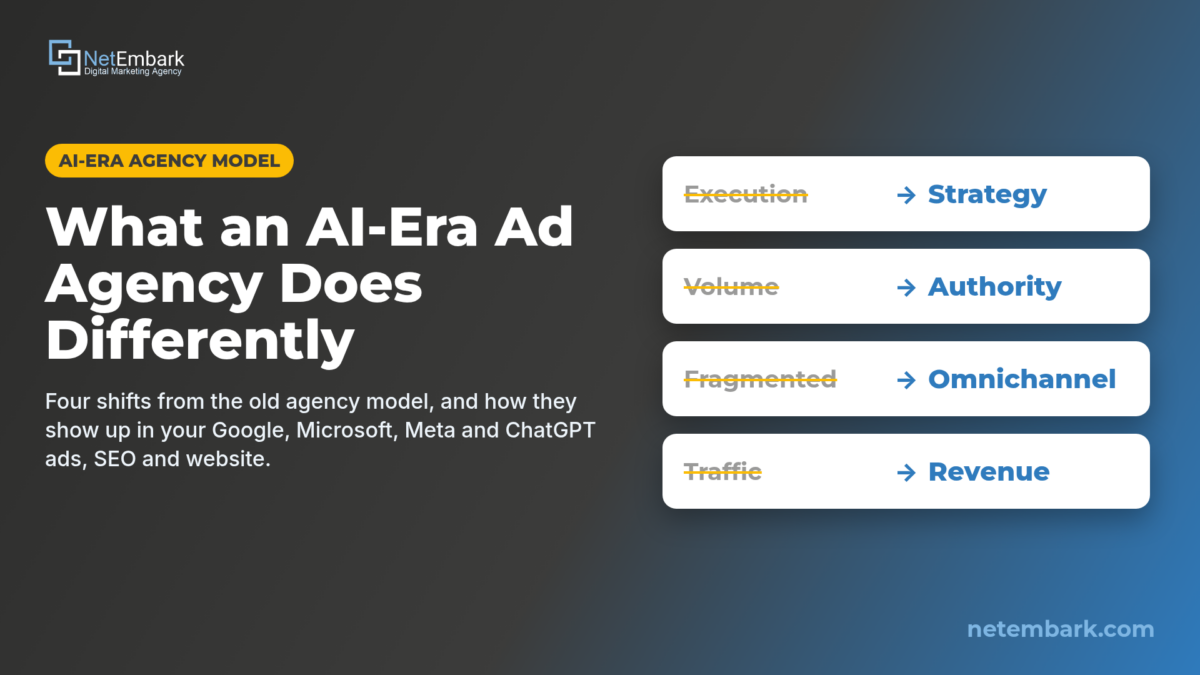
Short answer: An AI-era ad agency lets AI handle repeat work like first drafts, reports and data pulls, and puts its people on four things: strategy and forecasting instead of manual execution, authority content instead of high-volume articles, one plan across Google, Microsoft, Meta and ChatGPT ads instead of separate campaigns, and results measured in calls, forms and booked consultations instead of clicks.
What does an AI-era ad agency do differently?
It spends less time doing tasks by hand and more time deciding what the tasks should be. An AI-era agency uses AI for the repeat work, then puts its people on strategy, authority-building content, a single plan across channels, and measurement tied to revenue.
The old agency model was built on output: ads written, reports sent, posts scheduled, articles published. Much of that output can now be drafted by AI in minutes. McKinsey’s June 2026 report on the agentic advertising economy puts it plainly: for agencies, execution “is becoming a less defensible position compared to orchestration,” which it describes as helping clients design AI-enabled workflows, govern automated decisions, interpret platform signals and prove business outcomes.
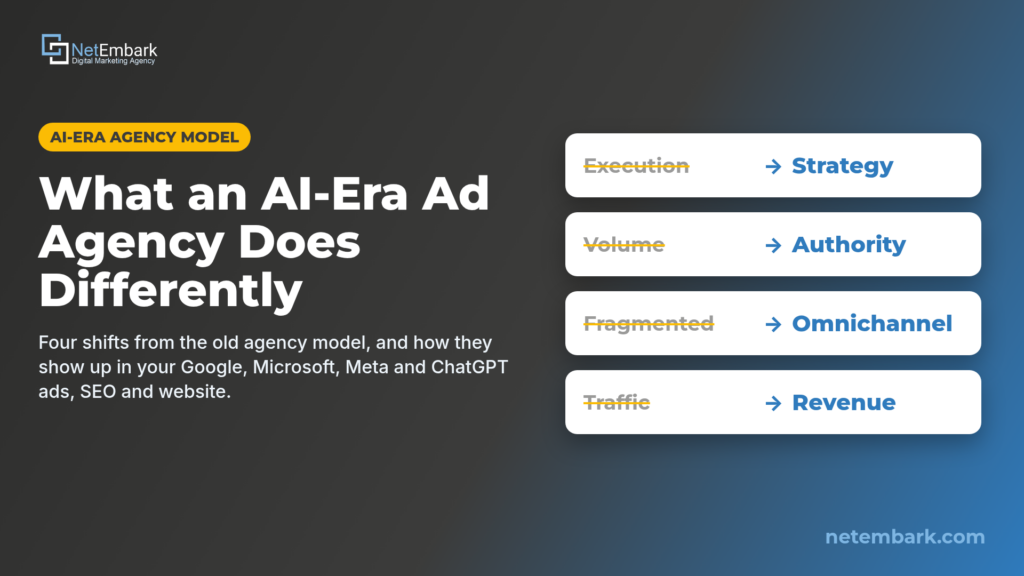
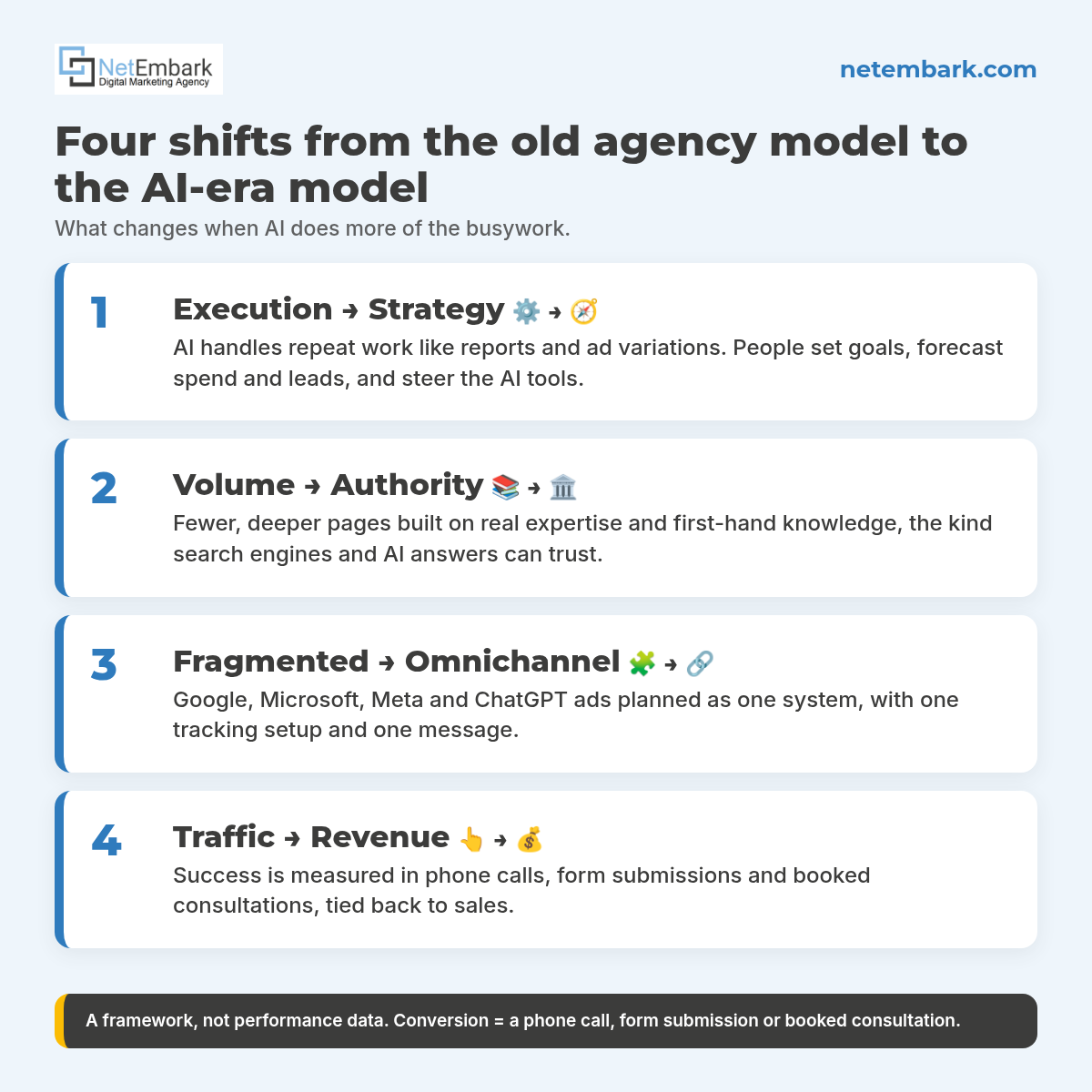
In practice, that comes down to four shifts:
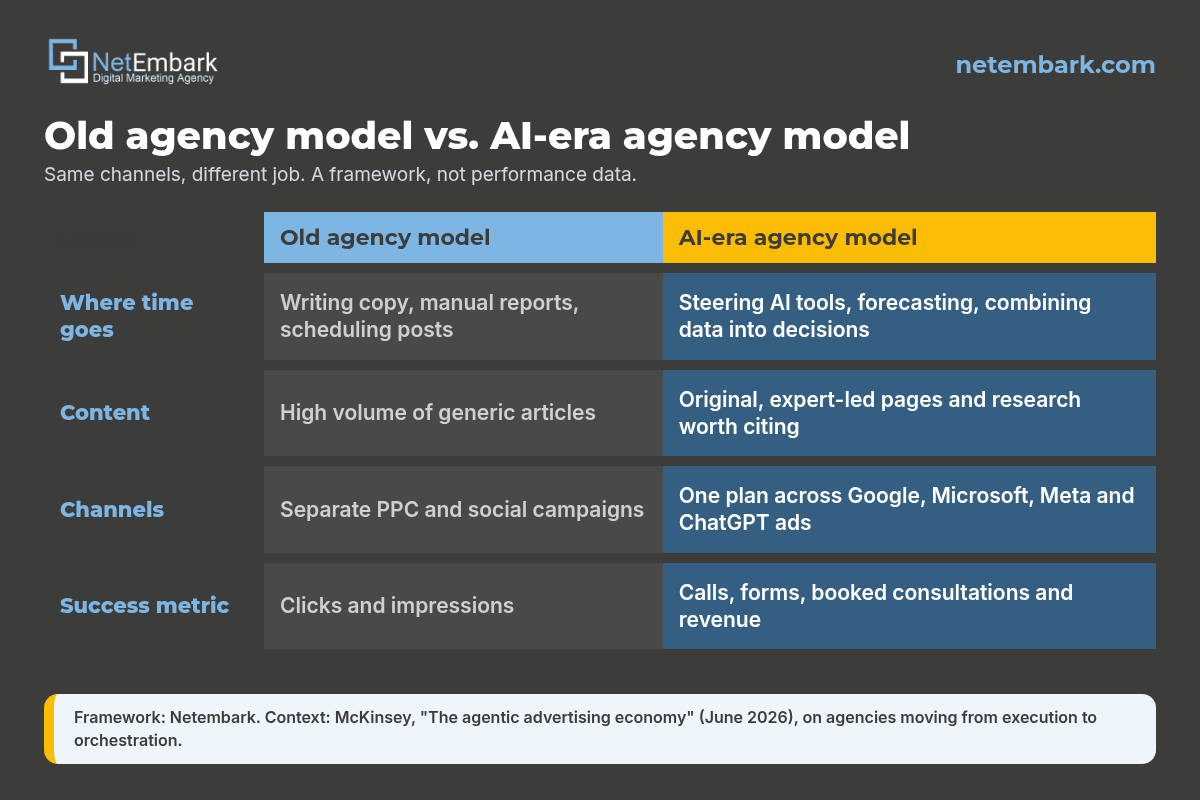
Here’s what each shift looks like, and what to ask an agency about it.
Video transcript
- What does an AI-era ad agency actually do differently? Here are four shifts from the old agency model.
- First, execution to strategy. AI can draft reports and ad variations, so people spend their time setting goals and steering.
- Planning starts with forecasts. Google's Performance Planner projects spend and conversions before budgets change.
- Second, volume to authority. Google treats mass-produced, low-value pages as spam, however they're made. Expertise wins.
- Third, fragmented to omnichannel. Google, Microsoft, Meta and ChatGPT ads work as one plan with one tracking setup.
- Fourth, traffic to revenue. Count phone calls, form submissions and booked consultations, not clicks.
- AI doesn't replace judgment. Goals, guardrails, brand decisions and approvals stay with people.
- Ready to bring AI into your marketing? Visit netembark.com/contact-us, call 800-707-2697, or email info@netembark.com.
How does AI move an agency from execution to strategy?
AI takes on the repeatable work, like first drafts of ad copy, report summaries and data pulls, so strategists can spend their time on forecasting, combining data from different channels, and steering the ad platforms’ AI tools toward the right goals.
This is already happening across the industry. In Basis’s 2026 survey of 184 marketing and advertising professionals, 51.1% of marketing organizations said they use AI agents. The most common jobs were reporting and analytics (72.3%), drafting campaign briefs (56.4%), creating content (45.7%) and planning media (35.1%).
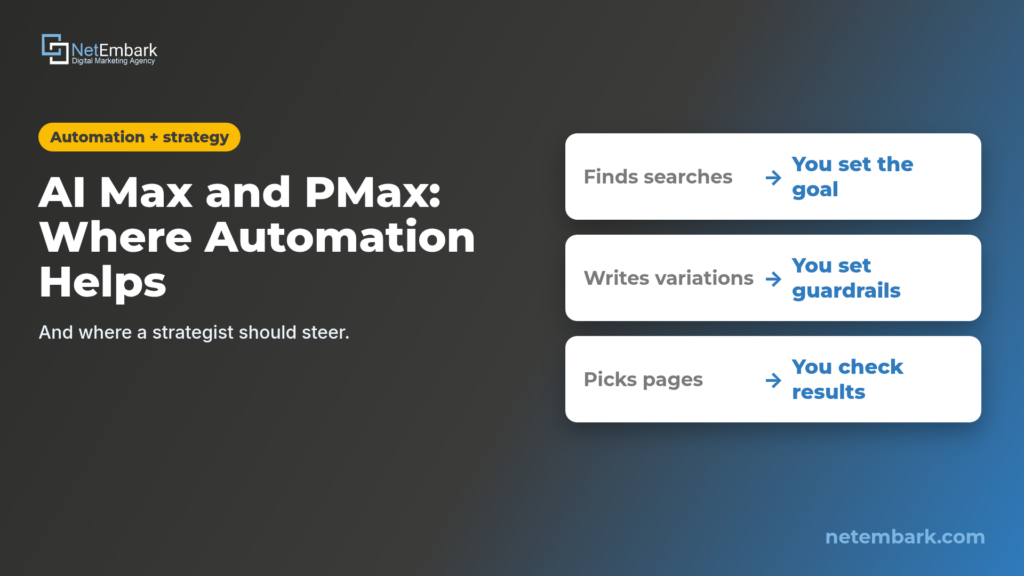
The ad platforms are moving the same way. Google’s Performance Planner forecasts how budget and bid changes might affect conversions, and Google says its forecasts are refreshed daily. AI Max for Search and Performance Max use Google AI to match queries, combine creative and bid in real time. Those tools work best when someone sets the right conversion goals, guardrails and tests. See our guide on whether to turn on AI Max for how we test it.
What stays human: deciding which goals matter, approving changes that spend money or make public claims, protecting the brand voice, and reading results in the context of the business. That’s where an agency earns its place now.
Why does authority beat volume in SEO and AI search?
Because Google treats mass-produced, low-value pages as spam however they’re made, and AI answers tend to draw on sources that show real expertise. A handful of deep, original pages usually does more than hundreds of generic ones.
Google’s spam policies define scaled content abuse as “many pages are generated for the primary purpose of manipulating search rankings and not helping users,” and list “using generative AI tools or other similar tools to generate many pages without adding value for users” as an example. Its guide to helpful, people-first content asks whether content shows “first-hand expertise and a depth of knowledge.”
AI search raises the stakes. In the McKinsey report, one marketing leader said, “Brands have to work on becoming a cited source … so that AI can pick up their content and put it as a relevant answer.” Google is also showing ads inside AI experiences; see are Google ads showing in AI Mode.
Authority content looks like:
- Original knowledge: your own process, your own customer questions, data from your own business.
- Direct answers: clear questions as headings and a plain answer up top, so people and AI systems can both find it.
- Proof of who you are: real people, real locations, real credentials, and a fast, easy-to-use site.
- Fewer, better pages: no copy-paste town pages and no keyword stuffing.
This is the approach behind Netembark’s SEO and AEO services.
What does omnichannel orchestration look like for ads?
Instead of separate PPC and social campaigns, each judged on its own numbers, every channel is planned as part of one customer journey, with the same conversion goals, one tracking setup and consistent messages and landing pages.
Google already pushes in this direction: Performance Max lets you “access all Google Ads inventory, including YouTube, Display, Search, Discover, Gmail, and Maps, from a single campaign.” An AI-era agency applies the same thinking across platforms:
| Channel | Its job in the plan | How it’s judged |
|---|---|---|
| Google Search with AI Max | Captures people actively searching, with AI-expanded matching you test before rolling out | Same conversion goals as every other channel |
| Google Performance Max | Reaches YouTube, Display, Search, Discover, Gmail and Maps from one campaign | Feed it real leads, not page views |
| Microsoft Advertising | Adds searchers on Bing, Copilot and Outlook | Compare on cost per real lead |
| Meta (paid social) | Builds demand with people who aren’t searching yet | Judge by leads and consults, not likes |
| ChatGPT ads | Shows up while people research and compare in ChatGPT | A newer channel: start small, measure closely |
| SEO and AEO | Earns organic visibility and citations in AI answers | Track calls and forms from organic, too |
| Website and landing pages | Turns every channel’s visits into calls, forms and bookings | Where every conversion is counted |
The website ties it together. If landing pages are slow or confusing, every channel pays for it; see our web design services guide. Budget follows the plan, not habit; our Google Ads budget guide walks through how to set one.
Talk to Netembark about bringing AI into your marketing → · Call (800) 707-2697
Why measure revenue instead of clicks and impressions?
Clicks and impressions show activity, not business results. An AI-era agency measures phone calls, form submissions and booked consultations, then connects those back to sales so the ad platforms’ AI learns what a valuable customer looks like.
Smart Bidding can only optimize toward what you tell it to count. Google’s enhanced conversions improve measurement with hashed first-party data, and offline conversion imports let you send back which leads became customers. Data-driven attribution gives credit across the ad interactions that led to a conversion instead of only the last click.
Many teams aren’t there yet. In the same Basis survey, only 6.5% of organizations said they evaluate their AI investments against defined metrics and benchmarks. An agency should be able to show you, in plain numbers, how ad spend turned into leads.
At Netembark, a conversion is a phone call, a form submission or a booked consultation. On average, Netembark’s paid ad campaigns generate a 12–16% conversion rate (12–18% for medical clients). That’s an average across campaigns, not a guarantee.
How does Netembark help companies integrate AI into their marketing?
Netembark, a verified Google Partner (Google Premier Partner 2016–2023), uses AI tools to speed up the routine work and puts its strategists on the four shifts: forecasting and steering, authority content, one plan across channels, and measurement tied to calls, forms and booked consultations.
- Paid search and AI campaigns: Google Ads management, including AI Max and Performance Max tested against real lead goals, run with Netembark’s proprietary ad management.
- Across platforms: Microsoft ads (Netembark is a Microsoft Advertising Partner), Meta ads (a Meta Business Partner) and ChatGPT ads, planned together.
- Authority and AI visibility: SEO and AEO built on answer-first, expert content and structured data.
- Conversion-ready websites: web design from code fixes and landing pages for testing to full lead-gen and ecommerce sites.
- Speed: Google Ads campaigns go live 2–4 days after the insertion order is signed.
Netembark is headquartered in Freehold, NJ, with offices in New York and Florida. Learn more about Netembark.
What should you ask an agency about how it uses AI?
Ask where AI sits in their workflow, who approves what it does, and how they’ll prove it’s producing leads. Vague answers are a warning sign.
- Which tasks does AI handle, and which do people always review?
- How do you forecast spend and leads before changing budgets?
- How do you test tools like AI Max or Performance Max before rolling them out?
- How do you keep content original and expert-led instead of mass-produced?
- How do Google, Microsoft, Meta and ChatGPT ads share one tracking plan?
- What counts as a conversion, and how will we see it tied to revenue?
Frequently asked questions
What is an AI-era ad agency?
An agency that uses AI for repeatable work like drafting, reporting and data pulls, and puts its people on strategy: forecasting, steering ad platform AI, authority content, one plan across channels, and measurement tied to revenue.
Will AI replace marketing agencies?
AI is replacing a lot of hands-on execution, not the need for strategy. McKinsey's June 2026 report says execution is becoming less defensible for agencies than orchestration: designing AI workflows, governing automated decisions and proving outcomes.
Is AI-generated content bad for SEO?
Not by itself. Google's spam policies target content made at scale mainly to manipulate rankings without adding value, however it's produced. Original, expert, people-first content is what to aim for.
What is omnichannel orchestration in advertising?
Planning Google, Microsoft, Meta and ChatGPT ads, plus SEO and your website, as one customer journey with shared conversion goals, one tracking setup and consistent messages, instead of separate campaigns judged on their own numbers.
Why are clicks and impressions not enough?
They show activity, not results. Measuring phone calls, form submissions and booked consultations, and feeding them back to the ad platforms, lets bidding optimize toward customers instead of visits.
Does Netembark use AI Max and Performance Max?
Yes. Netembark runs Google Ads including AI Max for Search and Performance Max, tested against real lead goals before they're rolled out more widely.
What counts as a conversion at Netembark?
A phone call, a form submission or a booked consultation.
How fast can Netembark launch campaigns?
Google Ads campaigns go live 2–4 days after the insertion order is signed.
Ready to bring AI into your marketing the right way? Talk to Netembark, a verified Google Partner (Google Premier Partner 2016–2023). Contact Netembark, email info@netembark.com, or call (800) 707-2697.
Sources (read November 2, 2026): McKinsey, The agentic advertising economy: From attention to action (June 16, 2026); Basis, AI and the Future of Marketing: 2026 Edition (October 2026); Google Search Central, Spam policies for Google web search and Creating helpful, reliable, people-first content; Google Ads Help, About Performance Planner, About Performance Max campaigns, About AI Max for Search campaigns, About enhanced conversions, About offline conversion imports and About data-driven attribution.
Netembark LLC · Verified Google Partner (Google Premier Partner 2016–2023) · 42 E Main St, Suite 202, Freehold, NJ 07728 · (800) 707-2697 · info@netembark.com · @netembark
Want help with your Google Ads?
Book a free strategy call with our verified Google Partner team. We’ll review your account and show you where the leads are.
Gary Pyatigorsky is the founder and CEO of Netembark, a verified Google Partner agency (Google Premier Partner 2016–2023) managing Google Ads, SEO and AEO since 2009.